
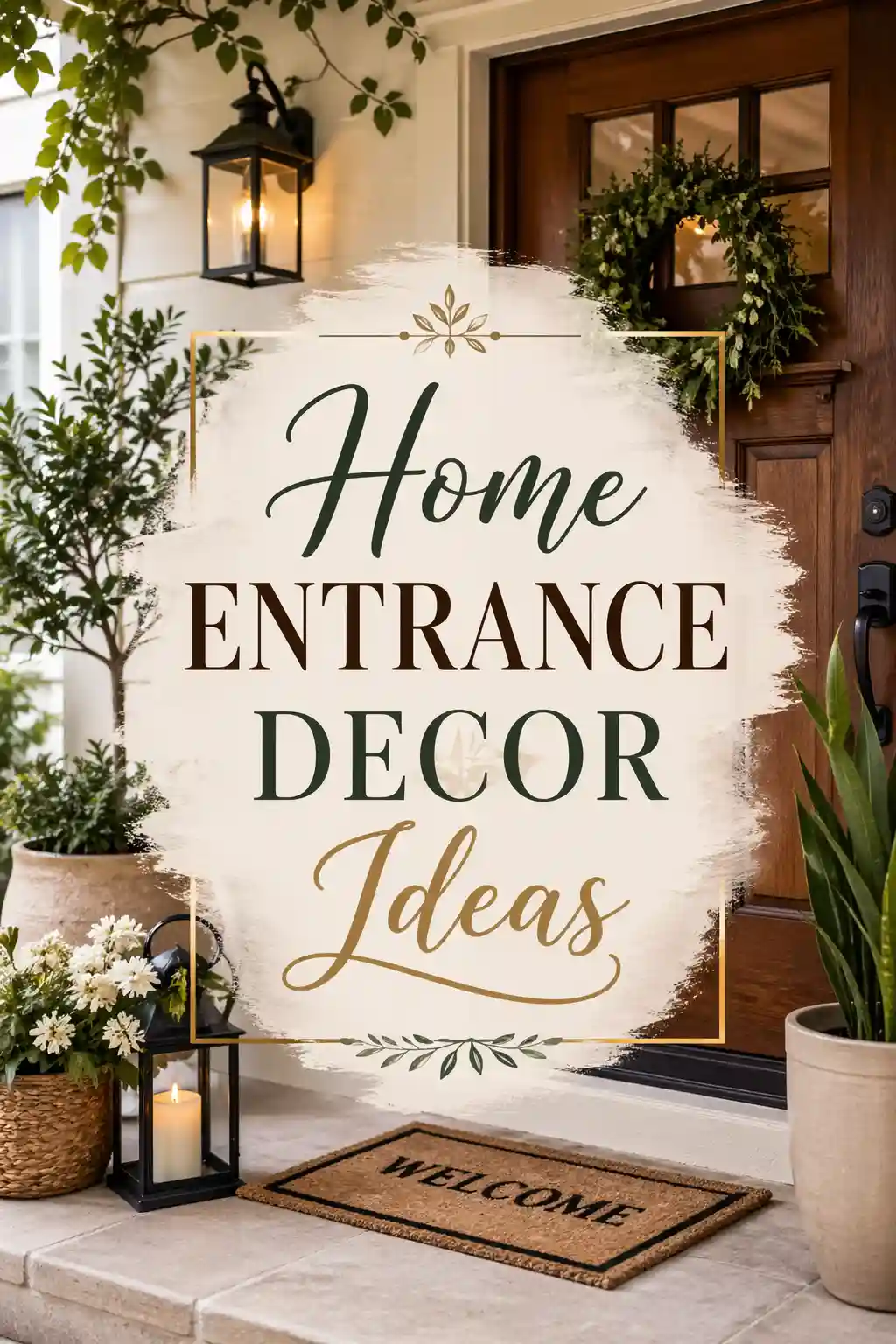
I have moved house three times in the past twelve years, and each time the thing that made me fall in love with a property before I even stepped inside was the entrance. Not the kitchen, not the garden, not the square footage on the listing. The entrance. The way the front door looked. The light above it. The plants beside it. The feeling of the whole thing as I walked up the path.
That experience taught me something I think a lot of homeowners genuinely miss: the entrance to your home is not just a practical transition point between outside and inside. It is a statement. It is the first sentence of the story your home tells about the people who live in it. And like any good first sentence, it deserves to be crafted with real intention.
If you have been searching for home entrance decor ideas that go beyond the obvious, you are in exactly the right place. I have pulled together ninety ideas across every style, budget, and space type in this article from grand statement entrances with double doors and dramatic lighting to tiny apartment hallways where a single thoughtful decision transforms the whole experience of coming home.
Everything here comes from real experience things I have tried myself, things I have seen work brilliantly in friends’ homes, and ideas I have picked up from interior designers over years of being genuinely obsessed with this subject. Let us get into it.
Also Read : 125+ Outdoor Living Space Ideas to Create a Cozy, Stylish Backyard Retreat That Feels Like a Second Home
Why Home Entrance Decor Ideas Matter More Than Most People Realise
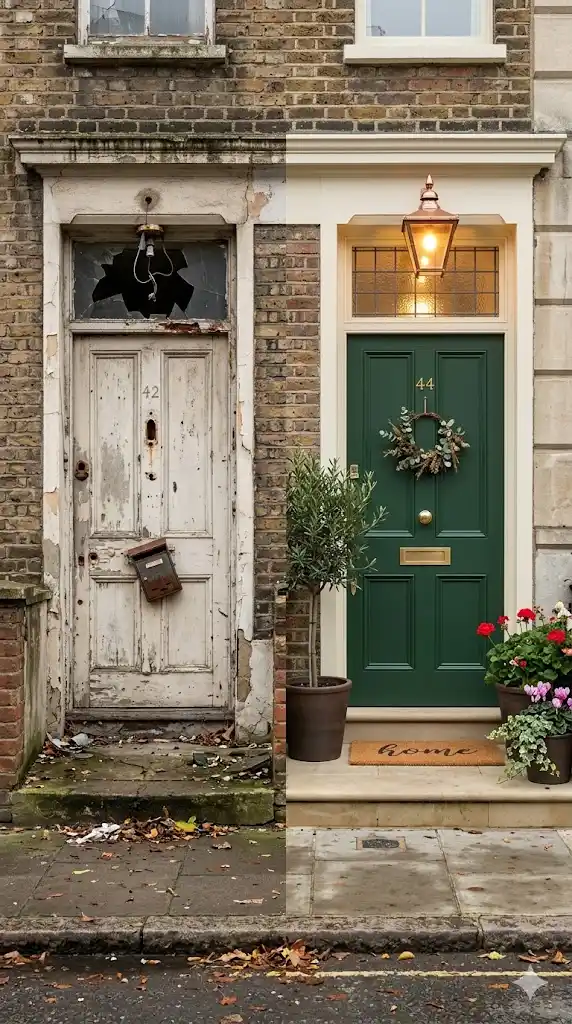
Psychologists have a concept called the primacy effect the idea that the first thing we experience in any situation disproportionately shapes our entire impression of it. Applied to home design, this means your entrance sets the emotional tone for everything else inside. Walk into a home through a beautiful, welcoming entrance and you are already predisposed to find the rest of it wonderful. Walk in through something neglected and uninviting and you are fighting that impression for the rest of the visit.
For homeowners rather than visitors, the entrance matters in a completely different but equally important way. Coming home at the end of the day is a psychological transition from the world outside to the sanctuary inside. A well-designed entrance that feels intentional, warm, and welcoming makes that transition a genuine pleasure rather than just a practical pass-through that you barely notice.
And from a completely practical standpoint, first impressions affect property value. Estate agents consistently say that kerb appeal which begins with the entrance can meaningfully affect both the speed of a sale and the price achieved. A well-presented entrance signals that the rest of the home is equally cared for, even before buyers step inside. Investing in your entrance is, in every sense, smart.
The Three Layers of a Great Entrance
When I think about what makes an entrance genuinely work, I always break it down into three layers. The first is the architectural layer the door itself, the framing, any path or steps leading to it, and the structure that surrounds it. The second is the decorative layer — the plants, the lighting, the doormats, the furniture, and the accessories that bring character and personality. The third is the sensory layer the smell, the texture, the warmth or coolness of the space, and everything that creates an atmosphere even before you consciously notice it.
Most home entrance decor ideas address the second layer, which is the right place to start. But the entrances that truly impress are thinking about all three simultaneously. A beautiful door with great lighting and beautiful plants but a cracked path and peeling mortar around the frame still does not quite work. Getting all three layers pulling in the same direction is the goal, and it is more achievable than most people think.
Also Read : 35 Genius Downstairs Toilet Ideas That Instantly Transform Small Spaces Into Stunning Statements
Front Door Home Entrance Decor Ideas: The First Thing Everyone Sees
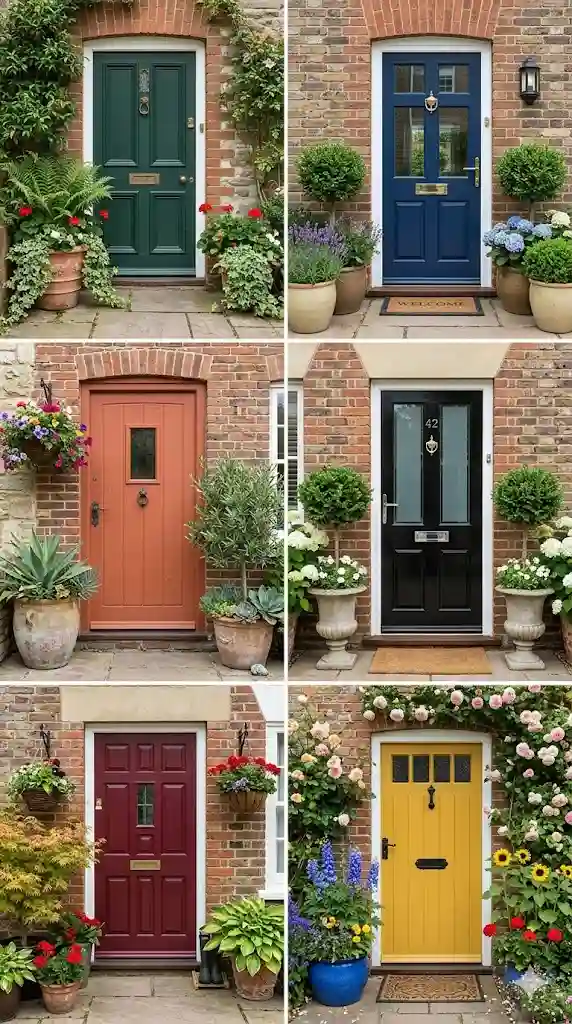
The front door is the centrepiece of any home entrance and the element that everything else supports and frames. Getting the door right is the single most impactful change you can make to a home’s exterior, and it costs far less than most major renovations. The quality of the door, its colour, its hardware, and its overall condition communicates volumes about what lies behind it.
Idea 1: Paint the Front Door a Bold Confident Colour
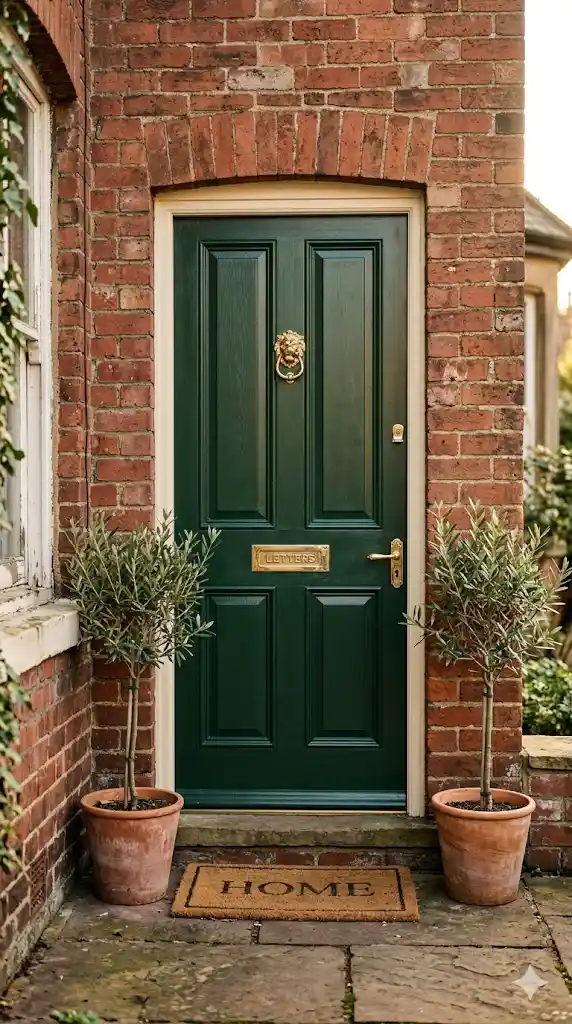
This is the number one recommendation from virtually every designer who works on home exteriors, and for very good reason. A front door painted in a strong deliberate colour signals confidence and personality in a way that a standard white or brown door simply cannot. Deep forest green, navy blue, glossy black, rich burgundy, terracotta, and a well-chosen mustard yellow are all current, beautiful choices that work across a wide range of exterior settings.
The key is to choose a colour that relates to the exterior material of your home. Brick homes warm beautifully to earthy terracottas, soft greens, and deep reds. Rendered white or grey exteriors can handle almost anything. Painted wood-clad homes look wonderful with navy or a soft sage. If you are unsure where to start, buy sample pots and test them on a small section of the door in natural daylight before committing to the full tin.
Also Read : 40 Stunning Front Porch Ideas That Transform Your Home’s Curb Appeal Overnight
Idea 2: Upgrade Your Door Hardware
Door hardware is the jewellery of a front entrance. A beautiful door with cheap, tarnished, or mismatched hardware is like a well-made outfit finished with the wrong shoes the overall impression is undermined by one wrong note. Replacing your door knocker, letterbox, handle, and house number with a coordinated set in the same finish brushed brass, polished chrome, matte black, or antique bronzeis one of the quickest and most cost-effective entrance upgrades available to any homeowner.
Brushed brass is currently the most popular finish for door hardware and with very good reason. It adds warmth and a sense of quality without looking brash or showy. Matte black works beautifully on darker doors and contemporary homes. Polished chrome suits more minimal, modern properties. Whatever you choose, make sure everything coordinates handle, knocker, letterbox, and number for a result that looks deliberately and thoughtfully considered.
Idea 3: Add a Side Panel or Transom Window
If your front door is a solid slab, adding glazing can dramatically improve both the look and the light in your entrance hallway. A side panel of textured or frosted glass beside the door, or a transom window above it, brings natural light into the hall without compromising privacy, and it architecturally frames the door in a way that makes the whole entrance feel more substantial and more generous.
This is a more significant project than painting, but it is not as complex or expensive as it might sound. Many door suppliers offer door sets that include a frame with side panels already specified. The impact on both the exterior look and the light quality inside the hall is significant and long-lasting.
Idea 4: Install a Statement Door Surround or Portico
A portico — a small covered structure above the front door supported by columns or brackets — immediately gives a home an air of architectural distinction. Even a modest timber canopy or a simple flat hood over the door provides shelter and frames the entrance in a way that feels considered and deliberate. In period homes, restoring an original portico or adding one sympathetic to the architectural style adds real visual authority.
For more contemporary homes, a flat projecting canopy in timber or powder-coated steel can achieve a similar effect with a cleaner, more modern silhouette. The key is proportion — the canopy or portico should be wide enough to shelter the doorstep comfortably and tall enough to feel generous rather than cramped against the facade.
Also Read : Transform Your Underground Space: 50+Brilliant Basement Ideas That Actually Work in Real Homes
Lighting Ideas for a Beautiful Home Entrance
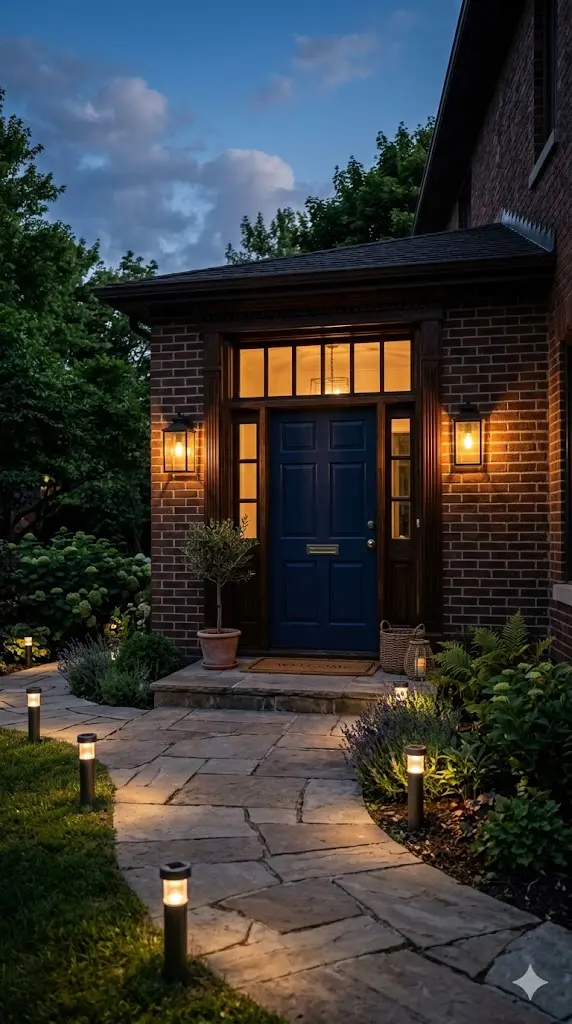
Lighting transforms an entrance from daytime-only beautiful to genuinely spectacular at all hours. A well-lit entrance creates a welcoming glow that can be seen from the street and communicates warmth and welcome before a visitor has even reached the door. Getting the lighting right is where most exterior home entrance decor ideas fall short, so it deserves real attention.
Idea 5: Traditional Lantern Wall Lights
A pair of matching lantern-style wall lights flanking the front door is one of the most classic and effective home entrance decor ideas for exterior lighting. The symmetry is architecturally satisfying, the warm light they cast is deeply welcoming, and a well-chosen lantern adds a period or heritage quality to the entrance that suits a wide range of home styles from Victorian terrace to Arts and Crafts cottage.
Look for lanterns in materials that complement your door hardware. A brass lantern pairs beautifully with brass door furniture, while a gunmetal or dark bronze lantern suits matte black hardware. Ensure the lantern is rated for outdoor use and has a good IP rating for weather resistance. Solar-powered lanterns have improved enormously in quality and are now a genuinely viable option for entrances where running mains cable is impractical.
Idea 6: Recessed Downlights in a Porch Ceiling
If your entrance has a covered porch, recessed downlights set into the porch ceiling provide a clean contemporary lighting solution that floods the doorstep with good quality light without any visible fitting cluttering the architectural lines. Always choose warm white at around 2700K to 3000K for an entrance — cool white light removes all the welcoming atmosphere and makes even the most beautiful entrance feel institutional and unwelcoming.
Position the downlights so they illuminate the doorstep directly without shining into the eyes of someone approaching. A single central downlight in a small porch works well. In a larger covered entrance, two or three downlights spaced evenly across the ceiling provide better and more consistent coverage of the whole space.
Idea 7: Path Lighting to Lead the Way
Lighting the path from the gate or street to the front door creates a sense of arrival that makes a home entrance feel genuinely considered, particularly after dark. Low-level bollard lights, recessed path lights set flush with the ground, or simple solar stake lights placed at intervals along the path all achieve this effect at different price points and with different levels of installation complexity.
The goal is a warm guiding light that draws the eye forward toward the door rather than harsh overhead illumination that removes all atmosphere. Keep the light level low and warm, and position it to illuminate the path surface and the plants beside it rather than shining directly upward or outward into the garden.
Idea 8: Uplighting Trees and Large Shrubs
If your home entrance has established trees or large architectural plants, uplighting them from ground level creates a dramatic and beautiful effect at night that few other interventions can match. A single well-positioned spike light aimed upward into the canopy of a mature tree beside the path, or at the base of a large topiary or architectural shrub, transforms the front of the house after dark entirely.
Ground spike lights for trees are available in solar and mains-powered versions and most have adjustable heads so you can direct the beam precisely. The warm golden light cast upward through foliage creates a dappled magical effect that is particularly striking against a dark evening sky and adds enormous drama to an entrance that reads as entirely ordinary during daylight hours.
Plant and Garden Home Entrance Decor Ideas
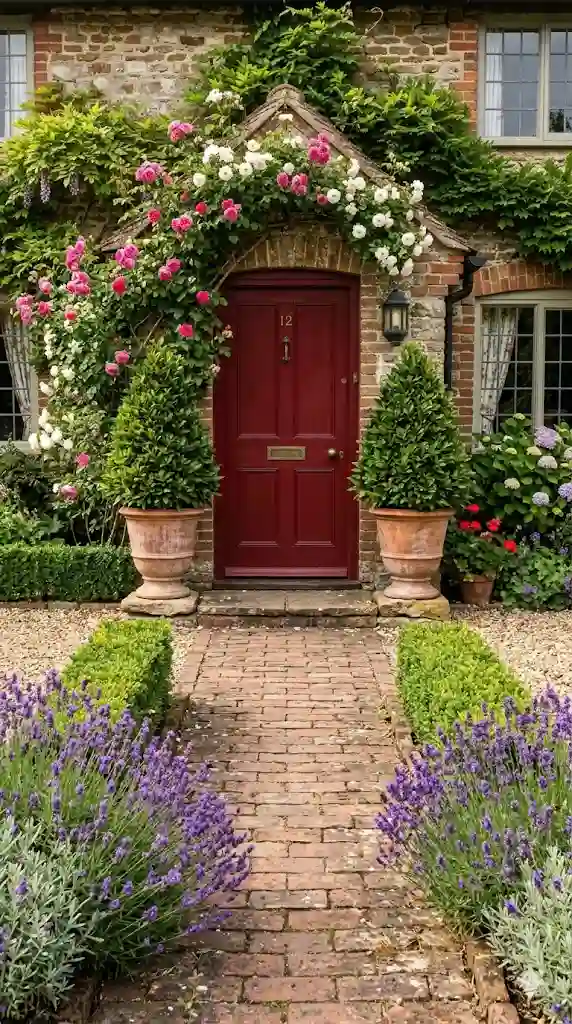
Plants are the most alive and dynamic element of any home entrance, and they can transform the look of a property more dramatically and affordably than almost any structural change. The key is choosing plants that suit your climate, your entrance conditions, and the level of maintenance you are genuinely going to give them. Beautiful plants that are clearly struggling do more harm than good to an entrance.
Idea 9: Flanking Topiary in Matching Pots
Two matching pots flanking the front door, each containing a neatly clipped topiary in a ball, cone, or standard lollipop form, is one of the most enduringly elegant home entrance decor ideas available. It creates immediate symmetry and structure, signals care and attention, and looks appropriately formal without being unwelcoming. Bay trees, box, and Portuguese laurel are the classic choices — all are reasonably tolerant of container growing and clip beautifully.
The choice of pot matters as much as the plant itself. Terracotta urns have a warmth and weight that suits period properties. Zinc or powder-coated metal planters look clean and contemporary. Washed concrete or stone-effect fibreglass pots suit modern homes with rendered exteriors. Whatever you choose, use matching pots on both sides for the satisfying visual balance that makes this idea work so reliably well.
Idea 10: Climbing Plants Up the Facade
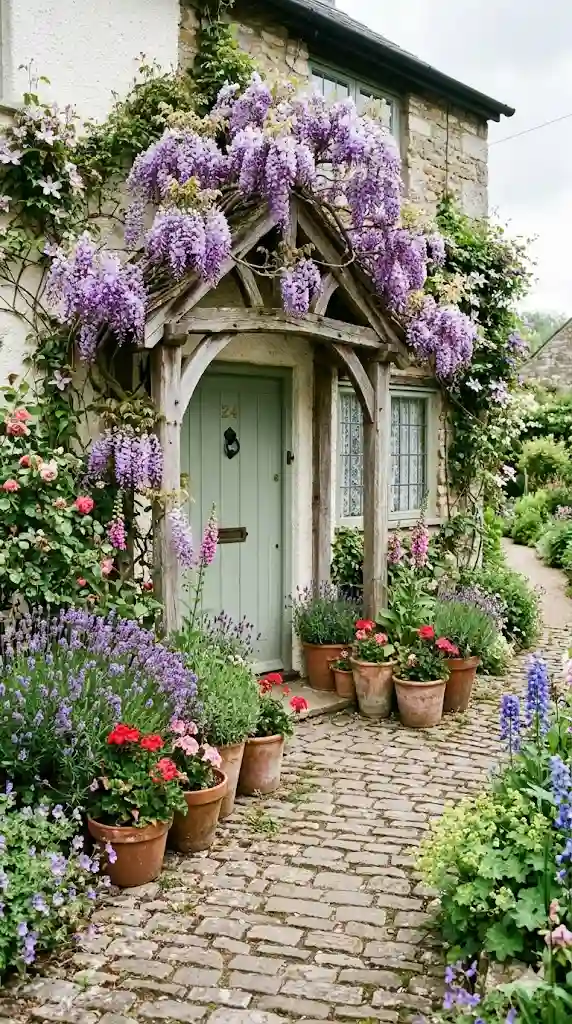
A climbing rose, wisteria, or hydrangea petiolaris trained up the wall beside or around a front entrance creates one of the most romantic and visually striking effects available in home entrance design. It takes time to establish, but once it does, a well-trained climbing plant frames the door and softens the architecture in a way that photographs beautifully across every season of the year.
Choose a climbing plant whose mature size and vigour is appropriate for your wall space. Wisteria is spectacular but very vigorous and needs significant pruning discipline. Roses in wall-trained varieties are more manageable and offer the double gift of flowers and fragrance. Hydrangea petiolaris is slower-growing but tolerates shade and north-facing walls where other climbers would simply fail.
Idea 11: Seasonal Planting in Window Boxes and Pots
For homeowners who want a front entrance that looks fresh and changing throughout the year, seasonal planting in window boxes and pots is the answer. Spring bulbs tulips, daffodils, hyacinths give way to summer bedding plants, which transition into autumn chrysanthemums and ornamental cabbages, then winter structure planting with evergreen grasses and berried stems.
This approach requires more regular effort than permanent planting but delivers a front entrance that always looks cared for and seasonally relevant. If maintaining multiple seasonal changes feels too time-consuming, even committing to a summer planting in bright pots and a simple evergreen arrangement for winter provides a satisfying rhythm of change that makes your home look beautifully maintained throughout the year.
Idea 12: A Statement Tree in a Large Container
A single large tree in a substantial container — a pleached hornbeam, a multi-stem silver birch, an olive tree, a large architectural palm in the right climate — creates the kind of home entrance statement that most people associate with high-end properties and boutique hotels. The scale is generous and confident, and the shadow and movement of a tree adds a life that no pot of bedding flowers can quite replicate.
Container trees need regular watering, feeding, and occasional root pruning to thrive long-term, but the visual return on that investment is extraordinary. An olive tree in a large terracotta amphora beside a beautifully painted front door is one of those combinations that makes almost any home entrance look immediately more considered, more beautiful, and more intentional.
Idea 13: Low Hedging to Define the Path
Low hedging planted either side of the path leading to the front door creates a sense of arrival and formality that is architectural in its effect. It separates the entrance from the surrounding garden, draws the eye forward toward the door, and provides year-round evergreen structure that looks smart in every single season. Even a simple low hedge of lavender adds fragrance and pollinator interest to the practical structural benefit.
Box blight has been a serious issue in recent years, so many gardeners now use Ilex crenata or Lonicera nitida as box substitutes. Both clip well and provide the same neat, dense hedge effect as traditional box. Lavender hedging along a path offers a more relaxed, fragrant, and enormously pollinator-friendly version of the same structural idea with the bonus of beautiful purple flowers in summer.
Hallway Home Entrance Decor Ideas: The Interior Entrance
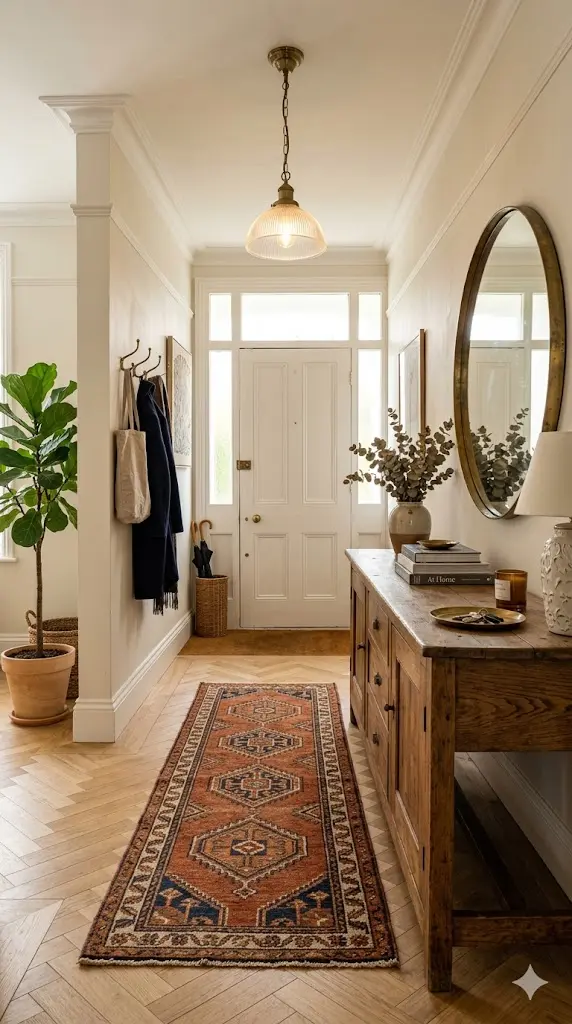
The entrance hallway the interior entrance of the home deserves as much attention as the exterior. It is the first room guests see and the last one they pass through when leaving. It sets the tone for the entire interior and provides the practical infrastructure for daily life: coat storage, shoe storage, key hooks, and the thousand small transitions of coming and going every single day.
Idea 14: A Statement Console Table
A console table is the foundational piece of furniture for almost any hallway, and choosing the right one sets the character of the whole space immediately. A slim marble-topped console on slender brass legs says something very different from a solid reclaimed oak table with heavy turned legs, even though both perform exactly the same function. Think about the style of the rest of your home and choose a console that is in genuine conversation with it rather than fighting against it.
Style the top of the console with restraint: a lamp, a vase of flowers or branches, a small tray for keys, perhaps one piece of art or a framed photograph. Less is almost always more on a hallway console, where visual clutter competes with the calming sense of order that a well-designed home entrance should always provide.
Idea 15: A Large Mirror Above the Console
The combination of a console table and a large mirror above it is one of the most reliable and beautiful home entrance decor ideas for hallways. The mirror does three things simultaneously: it reflects light to make the space feel larger and brighter, it provides a practical surface for a final appearance check before leaving, and it makes a strong visual statement that anchors the console and the wall it sits on in a satisfying way.
The mirror frame should be chosen with the same care as the console itself. A round mirror with a chunky wooden frame feels warm and organic. An arched mirror in a painted finish adds height. A gilded rectangular mirror with an ornate frame brings glamour. A simple frameless mirror cut to size feels ultra-modern. All of these work in different contexts the key is that the mirror feels like a deliberate choice rather than an obligation fulfilled.
Idea 16: Statement Wallpaper in the Hallway
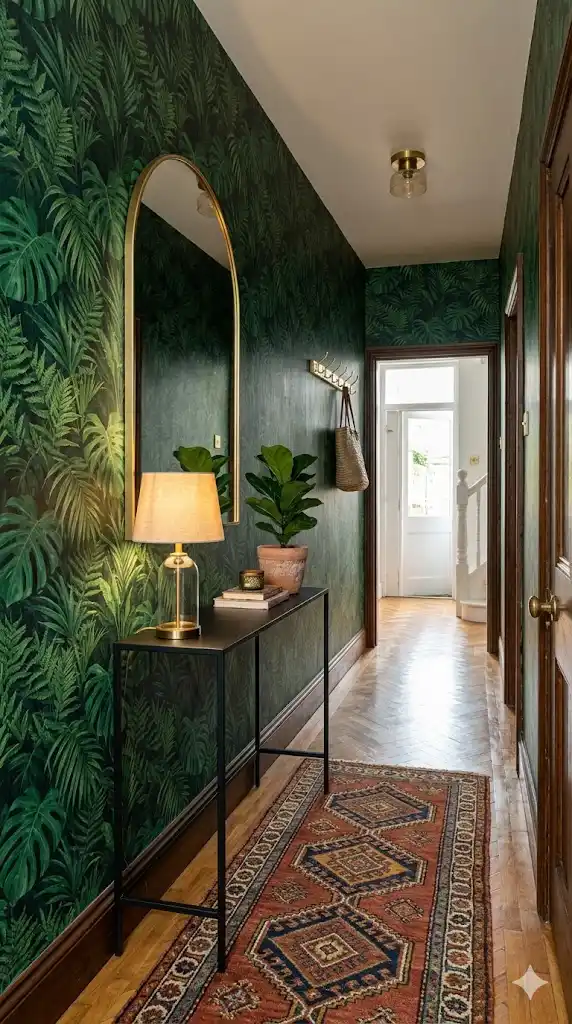
Because hallways are typically narrow and often without windows, they are spaces where bold decorative choices work particularly well. Statement wallpaper a large-scale botanical print, a dramatic geometric pattern, a scenic mural, an elegant stripe transforms a plain corridor into something genuinely exciting and memorable. Guests pass through it in a matter of seconds, which means the impact is concentrated, immediate, and lasting.
The narrow width of most hallways means that even one roll of a premium wallpaper can cover an entire wall or in some cases the whole room. This makes hallways one of the most affordable spaces in which to use wallpaper that might feel too expensive or too bold in a larger room. Use this advantage and choose something you genuinely love rather than something merely safe.
Idea 17: A Vintage or Antique Rug
A beautiful rug in a hallway does several things at once. It protects the floor, it absorbs sound, it adds colour and pattern and warmth, and it signals immediately that someone has made a considered decorating decision. A vintage or antique rug — a Persian Kilim, a Turkish runner, a flat-woven Moroccan piece — adds an authenticity and richness that a brand new rug rarely quite achieves, and they are often available at very reasonable prices from antique markets and online vintage retailers.
For practical purposes in a working hallway, a flat-woven rug is more forgiving than a deep pile — it is easier to vacuum, less likely to be damaged by heavy traffic, and less likely to trip anyone carrying bags through the door. Choose a pattern with multiple colours so that it reads well with whatever else the rest of the hallway contains.
Idea 18: Dedicated Coat and Bag Storage
Nothing undermines a beautiful hallway faster than coats piled on a single inadequate hook, shoes scattered across the floor, and bags dumped against the wall. Dedicated, well-designed storage is not just a practical necessity in a hallway — it is a design statement in itself. A run of Shaker-style hooks in a consistent finish, a built-in bench with coat hooks above and shoe storage below, or a freestanding wooden coat stand all create a sense of order that makes the whole entrance feel calmer and more intentional.
In wider hallways, a built-in boot room area with a bench seat, hooks above, and cubbies below is one of the most practically impactful things you can do to improve daily life in a family home. In narrower spaces, a slim wall-hung unit with hooks and a small shelf above provides useful storage without taking up any floor space at all.
Idea 19: A Statement Light Fitting
The ceiling of a hallway is an often-overlooked design opportunity that most homeowners simply ignore. Most hallways have a single unremarkable ceiling fitting that casts flat light and adds nothing visually to the space. Replacing it with a statement pendant — a cluster of smoked glass globes, a sculptural rattan shade, an industrial factory-style fitting, a classic lantern — immediately lifts the visual quality of the entire entrance.
In a narrow hallway where a hanging pendant might feel too low, wall sconces provide a warm layered lighting option that takes up no vertical space at all. A pair of matching wall sconces on either side of the mirror above the console is one of the most elegant hallway lighting solutions, giving both practical illumination and a satisfying visual symmetry that elevates the entire entrance.
Idea 20: Art on the Hallway Walls
Hallway walls are very often treated as transition spaces that do not deserve art — they are just walls you walk past in a hurry. This is a genuinely missed opportunity. Art in a hallway creates a gallery-like quality that makes the whole house feel more curated and considered, and it gives guests something interesting to notice and enjoy as they arrive and depart.
A single large statement piece of art on the main hallway wall makes a powerful impact. A salon-style gallery wall with multiple pieces in coordinating frames tells a more complex and personal story. Even a series of simple black-framed botanical prints bought inexpensively and hung in a neat row communicates an attention to detail that elevates the whole space considerably.
90 Home Entrance Decor Ideas: The Complete Curated List
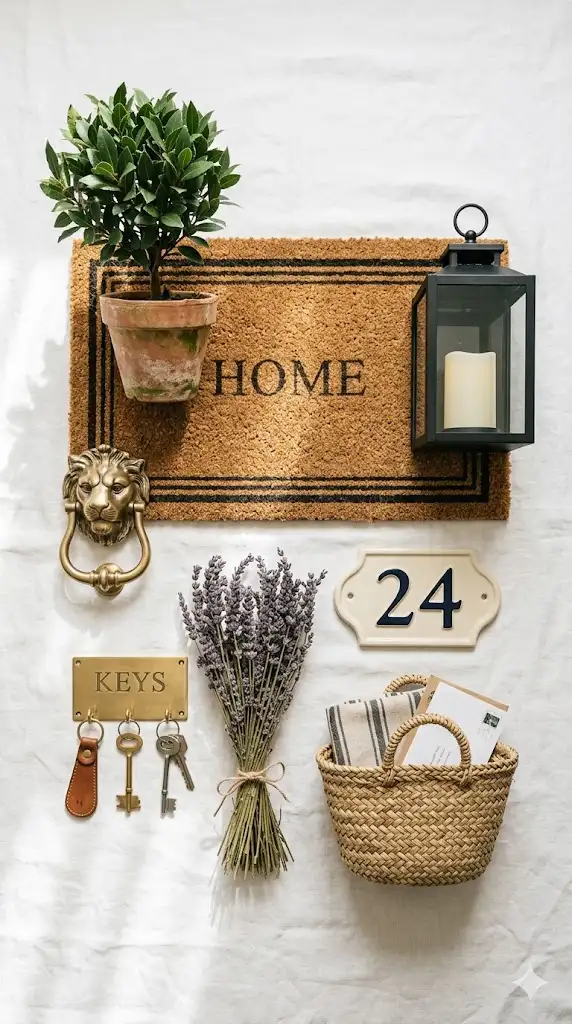
Here is the full collection of ninety home entrance decor ideas I have gathered, tested, and genuinely recommend. Some are quick wins that take an afternoon and cost very little. Others are longer-term projects that require planning and real investment but deliver proportional rewards. All of them genuinely work in real homes.
Exterior Entrance Ideas 21 Through 40
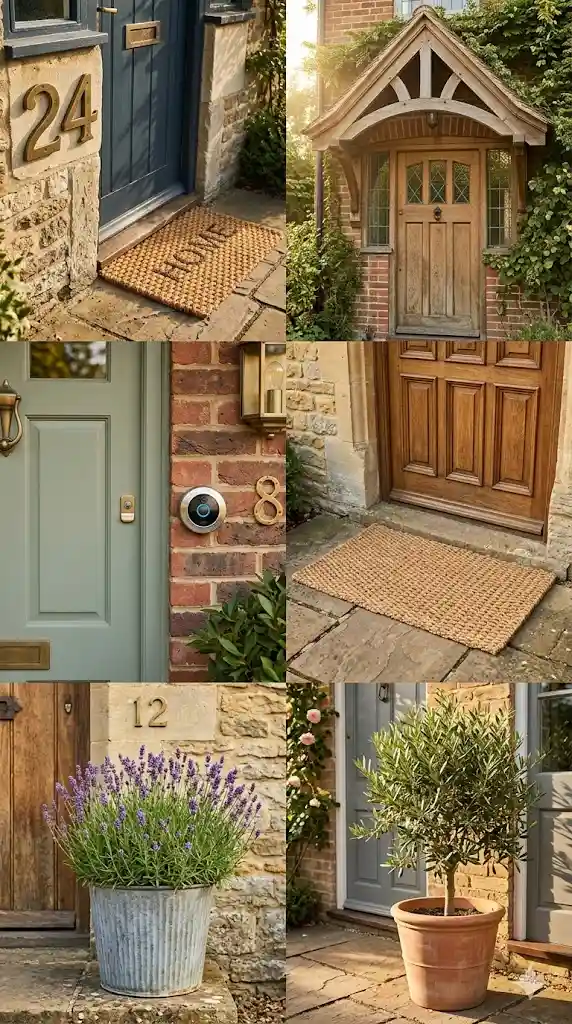
21: Replace your house numbers with large well-designed numerals in a finish that matches your door hardware.
22: Add a new doorbell in a finish that coordinates with your door hardware a video doorbell in brushed nickel or matte black now looks designed rather than purely technical. Idea
23: Lay a new doormat a quality natural coir mat with a simple border, a personalised mat, or a patterned rubber mat. The doormat is more visible than people realise and a worn cheap one undermines everything around it.
24: Add a boot scraper beside the door a simple cast iron boot scraper is both practical and characterful, particularly in rural and country homes. Idea
25: Install an architectural canopy or door hood in painted timber or powder-coated metal to provide shelter and frame the door.
26: Paint the window frames and sills to match or complement the door colour for a more cohesive and intentional exterior palette.
27: Add shutters to windows flanking the front door for an instant boost of architectural character and visual interest.
28: Repaint or re-render exterior walls if they are looking tired fresh masonry paint is one of the most transformative exterior investments available.
29: Install a new path surface reclaimed brick, natural stone, or gravel with timber edging all look significantly better than cracked concrete.
30: Add a timber gate at the property boundary to create a true sense of arrival before guests even reach the front door itself.
31: Plant bulbs in the borders either side of the path for seasonal colour that requires virtually no ongoing maintenance once planted.
32: Add an arch or pergola structure over the path or gate and train a climbing rose or clematis over it through the seasons.
33: Install a water feature near the entrance a simple self-contained fountain in a large pot or a wall-mounted water feature creates sound and movement that makes the entrance feel genuinely alive.
34: Add a stone or ceramic plaque beside the door with the house name if your home has one.
35: Install a postbox built into a wall or gate pillar rather than a basic slot in the door a well-designed freestanding postbox is a small but very telling detail.
36: Add a low wall or hedge to the front boundary to define the property and create enclosure that gives the entrance real presence.
37: Use matching galvanised metal or terracotta troughs planted with lavender along the front path edges for a unified and fragrant approach.
38: Add subtle exterior art a weathered metal sculptural piece or a mosaic inset in the path adds true originality to any home entrance decor.
39: Install a concealed exterior power socket near the entrance for seasonal lights and electric garden tools.
40: Add a recessed mat well in the doorstep so the doormat sits flush with the threshold, looking permanently built-in and tidy.
Hallway and Interior Entrance Ideas 41 Through 60
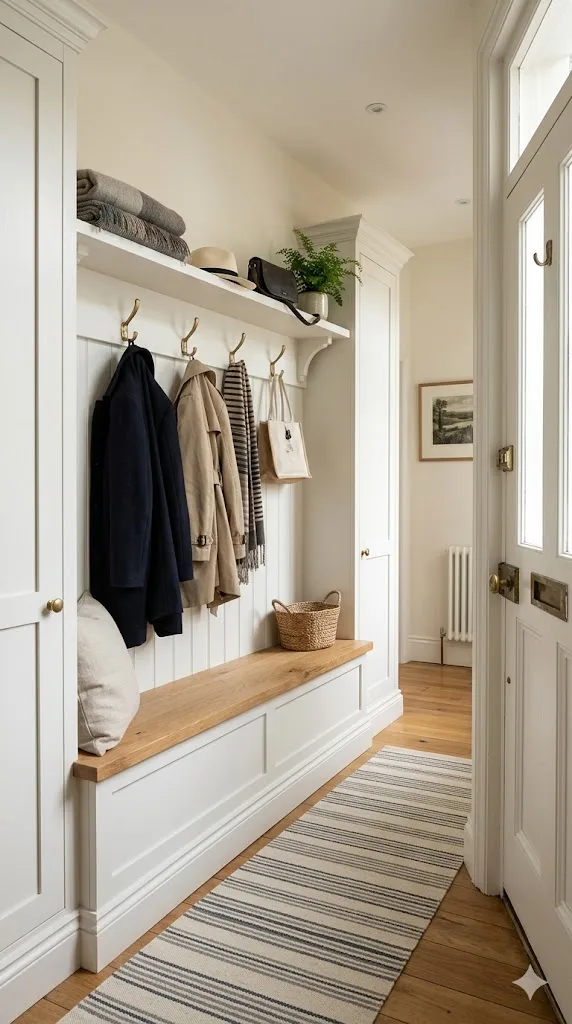
41: Paint the hallway in a deep rich colour midnight blue, bottle green, charcoal for an intimate enveloping quality that feels luxurious rather than small.
42: Install wainscoting or wall panelling in the lower half of the hallway for an instant architectural upgrade that adds real character.
43: Lay herringbone parquet flooring in the hallway no other flooring creates quite the same sense of quality and craftsmanship underfoot.
44: Use luxury vinyl tile in a parquet or stone pattern for the same elevated effect at a significantly lower price point.
45: Add a tall thin bookcase to a hallway wall books immediately add warmth and personality that no purely decorative object quite replicates.
46: Hang a series of family photographs in matching frames along the hallway it feels personal, welcoming, and genuinely unique to your household.
47: Add a small bench at the end of the hall for sitting to put on and remove shoes function and decoration beautifully combined.
48: Install picture rail so you can hang art without putting holes in the walls and can easily rearrange the display whenever the mood takes you.
49: Use a contrasting colour for the hallway ceiling a deep blue ceiling in a white hallway, or a warm terracotta ceiling in a neutral corridor, adds a surprising and genuinely delightful detail that most visitors notice and comment on.
50: Add a house plant tower with multiple tiers of trailing plants for a lush green vertical element in even the narrowest of hallways.
51: Install under-stairs storage in a hallway with a staircase built-in drawers, cupboards, or open shelving make use of dead space and dramatically reduce clutter throughout the home.
52: Add a scent diffuser or reed diffuser to the hallway a home that smells beautifully on arrival makes an impression that goes well beyond the visual.
53: Hang a dramatic oversized clock on the hallway wall both useful in the most practical daily sense and genuinely decorative.
54: Install a small shelf at shoulder height just inside the front door as a landing spot for keys, phones, and wallets the moment you come in.
55: Add a key cabinet that looks like a small framed artwork but opens to reveal key hooks inside clever, tidy, and always conversation-starting.
56: Use a hall table with drawers so that the practical detritus of daily life can be hidden away while the table surface remains beautifully styled.
57: Hang a large architectural plant print or framed herbariums for a botanical feel that requires zero maintenance.
58: Use the wall beside the staircase for a continuous gallery of art that leads the eye naturally upward through the home.
59: Install a period-appropriate cornice or ceiling rose in a hallway that lacks architectural detail these can be bought inexpensively and fitted in an afternoon.
60: Add a discreet wireless charging pad to the console table surface so the hallway also functions as a practical phone charging station for the whole household.
Styling and Accessory Ideas 61 Through 90
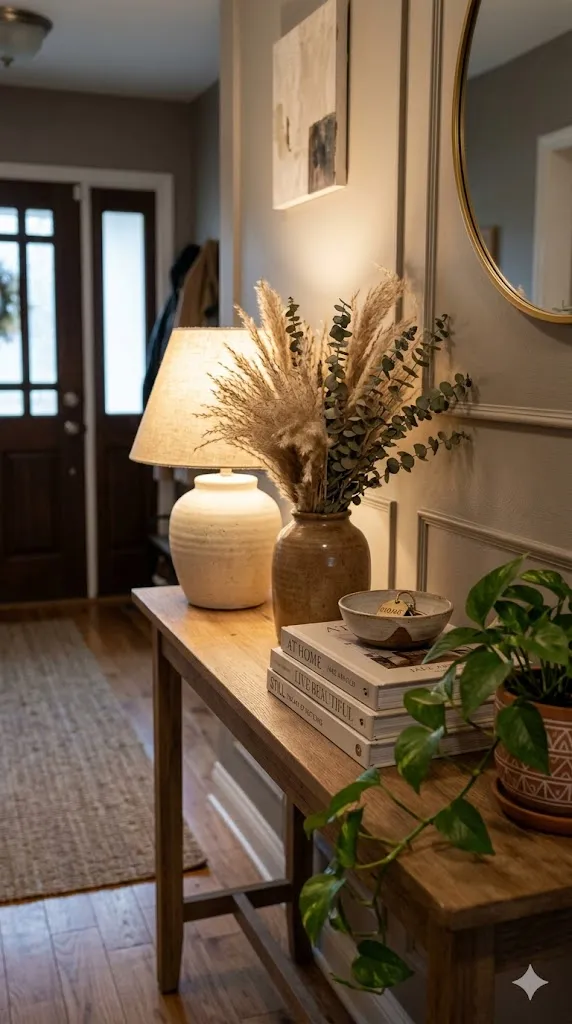
61: Style the console table with a lamp, a vase, and one sculptural object no more than three elements for maximum impact and minimum clutter.
62: Use dried flowers and branches rather than fresh ones for a low-maintenance display that lasts for months without attention.
63: Add a small tray on the console specifically for keys, coins, and daily essentials containment creates order in a space that otherwise becomes chaotic.
64: Use ceramic or stoneware accessories in earthy tones to add tactile warmth to a styled console or shelf.
65: Add a small bronze or brass sculptural object an abstract figure, an architectural model, an interesting found object for something unexpected and genuinely conversation-starting.
66: Hang a woven wall hanging or textile art in the hallway for texture and softness that paintings and prints simply do not provide.
67: Use a floor lamp with a slim profile in a corner of the hallway to add a third layer of warm, inviting light.
68: Add a small indoor water feature on the console or floor for the calming sound of moving water every time you enter and leave.
69: Place a large wicker or rattan basket below the console for umbrellas, walking sticks, or sports equipment practical and visually warm.
70: Use a decorative ladder propped against the wall for hanging throws or coats in a characterful and deliberately informal way.
71: Add a seasonal display to the console autumn leaves and dried seed heads, spring blossom branches, winter greenery that changes throughout the year and keeps the entrance feeling alive and current.
72: Frame a beautiful map of a place that matters deeply to you and hang it in the hallway it immediately invites conversation and tells visitors something real about who you are.
73: Use architectural salvage in the hallway a reclaimed church pew as a bench, an old school locker as shoe storage, a vintage post office sorting shelf for authentic character that cannot be bought new.
74: Add a monogram or initial letter as wall art it is personal without being overly sentimental. Idea 75: Display a collection of something meaningful vintage cameras, old books, interesting ceramics grouped purposefully together on a shelf or in a tray.
76: Use books as decoration as well as storage a small curated stack on the console adds colour, personality, and a sense of intellectual and cultural life.
77: Add window film to any glass panels in or around the front door for privacy without blocking light geometric or botanical films are beautiful in their own right.
78: Install a smart home hub or control panel in the hallway in a position and finish that feels genuinely considered rather than simply tacked on as an afterthought.
79: Add a pegboard on a hallway wall painted in a complementary colour, fitted with cups, hooks, and baskets for a functional and visually interesting organisation solution.
80: Hang a full-length mirror in the hallway if space allows it makes the space feel significantly larger and is enormously practical for daily use.
81: Use a wooden or rattan tray on the floor beside the door as a designated shoe-removal zone it frames the shoes and makes the habit feel deliberate rather than messy.
82: Add a chalkboard or whiteboard to the hallway wall for family messages, shopping reminders, and weekly plans that the whole household can see.
83: Display a piece of children’s artwork in a proper frame in the hallway it is both charming and deeply personal in a way that bought art never quite is.
84: Use the hallway ceiling for a hanging display a cluster of pendant lights at different heights, a macrame ceiling hanging, or suspended botanical branches create a genuinely spectacular overhead element.
85: Add a small table or stool beside the door at the right height to rest shopping bags while unlocking a tiny practical change that makes daily life meaningfully better.
86: Install a motion-sensor night light low on the hallway wall so the space is always gently lit after dark when movement is detected.
87: Use a colour-matched trim on the skirting boards and architraves painting these in a contrasting colour to the walls adds architectural articulation that immediately raises the perceived quality of the whole hallway.
88: Add a monochrome black and white photograph gallery along one hallway wall the restrained palette works beautifully in every stylistic context.
89: Place a sculptural vase on the floor in a corner of the hallway a large floor vase with dried stems or leafy branches fills empty corners beautifully and adds scale.
90: Commit to keeping the hallway clear of clutter every day all the design decisions in the world are undermined by an entrance that is constantly buried under coats, shoes, bags, and forgotten post. The most powerful home entrance decor idea of all is simply maintaining with care the space you have worked so hard to create.
Home Entrance Decor Ideas for Small Spaces
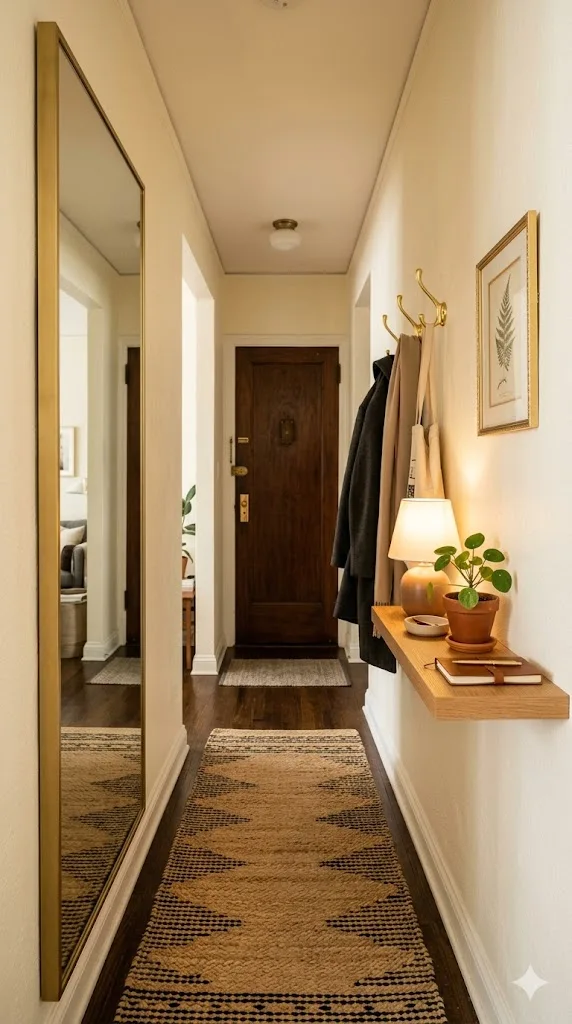
Not every home has a sweeping entrance hall or a generous front path. Many of the most inspiring home entrance decor ideas come from people working with genuinely challenging constraints a hallway barely wide enough to turn around in, a ground-floor flat with a front door that opens onto a shared corridor, or a terraced house where the front door leads almost directly into the living room.
Making a Tiny Hallway Feel Bigger
The tools for making a small hallway feel more spacious are well understood: mirrors, light colours, good lighting, and ruthless editing of clutter. A floor-to-ceiling mirror on one wall is the single most impactful intervention in a tiny hallway. It reflects both the light and the opposite wall, creating a visual depth that the eye reads convincingly as real extra space. Choose a mirror with a slim frame so the reflection extends as close to the wall edges as possible for maximum effect.
Wall-mounted storage — hooks, slim floating shelves, wall-hung key cabinets — keeps the floor clear and makes a cramped space feel significantly more manageable. Avoid anything that projects more than 15 to 20 centimetres from the wall in a narrow hallway. Every centimetre of floor space is precious. Keep the colour palette light and consistent, use the same floor material throughout without any threshold strips that interrupt the visual flow.
Apartment Entrance Decor Without a Hallway
Ground-floor apartments often have a front door that leads directly into a living space with no dedicated hallway at all. In this situation, creating a defined entrance zone — even a purely decorative one — helps the home feel more organised and the transition from outside to inside more psychologically intentional. A large rug positioned at the front door creates a visual landing zone. A coat stand and a small floating shelf just inside the door create a functional landing station that makes daily life considerably easier.
Even in a studio apartment where the front door opens directly into the only room, a simple folding screen or a tall bookcase positioned to partially screen the entrance from the main living area creates a psychological sense of transition that makes the whole space feel more considered and more comfortable to genuinely live in every day.
Seasonal Home Entrance Decor Ideas Throughout the Year
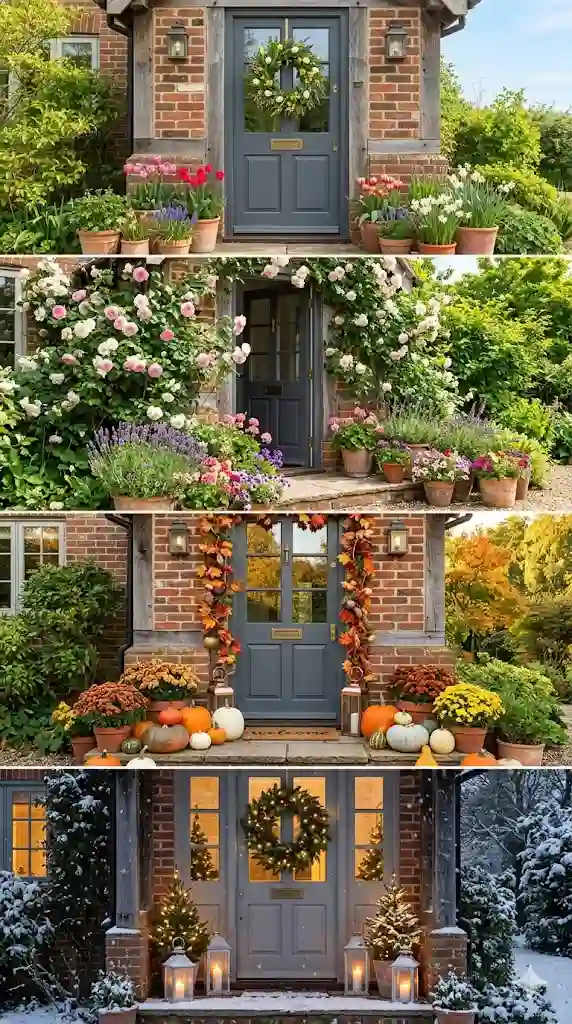
One of the joys of committing to a well-designed entrance is that it becomes a canvas for seasonal decoration throughout the entire year. The core structure the painted door, the hardware, the lighting, the permanent planting remains constant, while seasonal elements are introduced and changed as the calendar progresses and the natural world shifts around it.
Spring and Summer Entrance Decoration
Spring is the natural season for front entrance revitalisation. New planting, fresh flowers in pots, a new doormat, perhaps a fresh coat of paint on the door if it has been a year or two — all of these feel right and timely in March and April. A spring wreath on the front door made from twisted willow, early blossom, and small spring flowers signals the season joyfully and welcomes visitors with something genuinely cheerful and alive.
Summer entrance decoration is about lushness and generous colour. Full pots of geraniums, petunias, and trailing lobelia on the doorstep. Roses in bloom on the wall. Lavender in terracotta troughs sending fragrance up the path. The summer entrance practically decorates itself if the right planting has been put in place in spring — your job in summer is simply to water, deadhead, and genuinely appreciate what you have grown.
Autumn and Winter Entrance Decoration
Autumn is my personal favourite season for home entrance decor ideas. The rich copper, amber, and burgundy tones of the season make even a very simple entrance look warm and deeply inviting. A wreath of autumn leaves, seed heads, and dried berries on the door. Pumpkins and gourds grouped on the doorstep. Copper and bronze lanterns lit against the darkening evenings. The entrance starts to feel genuinely cosy rather than just welcoming.
Winter entrance decoration involves committing to warmth and light in what is often a cold and dark season. A quality evergreen wreath on the door not a cheap plastic one but something made from real greenery, pine cones, and berries is one of the most universally beautiful seasonal decorations available anywhere. Lit lanterns with pillar candles inside, a simple string of warm white lights around the door frame, and the scent of a candle just inside the door create a winter entrance that feels like a true sanctuary at the end of a cold day.
Final Thoughts
Every home entrance decor idea in this article serves the same ultimate purpose: creating a space that tells the right story about the people inside before anyone has even crossed the threshold. Whether that story is warm and maximalist, cool and minimal, romantic and botanical, or bold and contemporary, the entrance is always where it begins.
You do not need a large budget or a grand architectural setting to create a genuinely beautiful entrance. You need intention. You need to look at the space you have and ask what it could be rather than simply accepting what it currently is. A tin of paint, a new mirror, a pair of plants, and a quality doormat can collectively transform a tired entrance into something that makes you smile every single time you come home.
That feeling the quiet pleasure of a beautiful entrance at the end of a long day is worth every bit of effort it takes to create. Start with one idea from this list. See how it changes things. Then add another. The entrance to your home is never truly finished, but the moment you start treating it with the attention it deserves, the whole experience of where you live shifts in a way that is hard to fully explain but entirely impossible to ignore.
Frequently Asked Questions
1. What is the most important element of a home entrance?
The front door itself is the single most important element because it is the focal point that everything else supports and frames. A freshly painted door in a considered colour with good quality hardware immediately elevates the entire entrance regardless of what surrounds it. If you can only do one thing to improve your home entrance, paint the door a bold and beautiful colour.
2. How do I make my home entrance more welcoming?
The combination of good lighting, well-maintained planting, and a quality doormat creates a welcoming entrance without requiring any major financial investment. Warm light at the door signals habitation and generosity. Plants signal care and attention to the space. A good doormat invites visitors to pause and step in comfortably. These three elements alone transform the feel of most home entrances dramatically and immediately.
3. What colour should I paint my front door?
The most universally flattering front door colours are deep forest green, navy blue, glossy black, and rich burgundy. All of these work with a wide range of exterior materials including brick, render, stone, and timber cladding. The best approach is to choose a colour that either contrasts with or deepens the tone of your exterior walls rather than trying to match them exactly, which tends to produce a flat and unremarkable result.
4. How do I decorate a small entrance hall?
Use a large mirror on one wall to make the space feel considerably bigger. Keep storage wall-mounted to preserve every centimetre of floor space. Use a consistent light colour palette on the walls. Install good quality warm lighting. Edit accessories ruthlessly — in a tiny space one well-chosen piece looks elegant while three pieces looks cluttered. A slim console and a well-chosen rug are usually all the furniture a small hallway genuinely needs.
5. What plants are best for a front entrance?
Bay trees, box topiaries, and lavender are the classic choices for a front entrance because they are evergreen, tolerate container growing well, and maintain a tidy well-clipped appearance year-round. Olive trees work beautifully in sheltered or warm-climate entrances. Climbing roses and wisteria are spectacular against walls. For shade or north-facing entrances, ferns, hostas, and hydrangeas are more reliable performers than sun-loving species.
6. What should I put on a hallway console table?
The most satisfying console table styling uses a maximum of three to four elements: a lamp for light, a vase with flowers or branches for organic life, a small tray or bowl for daily essentials like keys, and optionally one sculptural or personal object that tells something true about who you are. Restraint is the key word. A console table cluttered with too many objects loses all visual impact and makes the hallway feel disorganised rather than welcoming.
7. How do I add more light to a dark hallway?
The most effective ways to add light to a dark hallway are installing a large mirror to reflect available light, upgrading the ceiling light to something with more warmth and output, adding wall sconces beside a mirror, and where structurally possible adding a glazed panel or transom window near the front door. Paint colour also makes a significant difference a mid-tone warm white reflects light far better than a bright cool white or a flat uninspiring magnolia.
8. What is a good rug for a hallway?
The best hallway rugs are flat-woven because they are easier to clean, more durable under heavy traffic, and less likely to create a trip hazard for anyone carrying bags or pushchairs. Vintage Kilim runners, flat-woven Turkish rugs, and woven cotton runners in geometric patterns are all excellent choices. Choose a pattern with multiple colours so it coordinates easily with the rest of the hallway and hides any dirt between cleanings.
9. How do I create a welcoming entrance with no outdoor space?
When the front door opens directly into a shared corridor or a living space, the focus shifts entirely to the immediate interior entrance zone. A coat stand and a floating shelf just inside the door create a functional landing area. A beautiful pendant light or floor lamp near the door creates a warm pool of light that defines the space. A statement rug at the threshold establishes the zone visually. And a reed diffuser ensures the first sensory experience of entering your home is always a beautiful one.
10. How do I make my hallway look more expensive?
The elements that most reliably make a hallway look more expensive are quality flooring such as herringbone parquet or natural stone, a statement light fitting rather than a basic bulb, a large properly framed mirror, coordinated hardware on all the doors, and ruthless tidiness. Many hallways look cheaper than they actually are simply because of clutter and inattention to detail rather than any inherent quality issue with the materials themselves.
11. What kind of lighting is best for a hallway?
Warm white lighting at around 2700K to 3000K is almost always the right choice for a hallway, as it creates the welcoming cosy atmosphere that makes a home entrance feel genuinely inviting. A combination of a ceiling pendant for general illumination and wall sconces or a table lamp for atmosphere creates a significantly better result than a single overhead light ever can. Dimmable fittings are worth considering in a hallway that also serves as an evening transition space.
12. How do I add storage to a narrow hallway?
Wall-mounted storage is the definitive answer to a narrow hallway. A row of Shaker hooks at coat height takes up no floor space at all. A floating shelf above the hooks provides a landing surface for bags and hats. A slim wall-hung shoe cabinet conceals footwear tidily behind closed doors. Under-stair storage, if the hallway has a staircase, should always be fully fitted out rather than left as completely wasted space that collects clutter.
13. Should I use the same flooring throughout the hallway and adjacent rooms?
Using the same flooring material throughout the ground floor — running through the hallway into the living room and kitchen without threshold strips — creates a visual flow that makes the whole interior feel more spacious and considerably more cohesive. If different flooring is needed for practical reasons, choose materials with a similar tone and finish to minimise the visual interruption at the transition points.
14. What are some unique front entrance decor ideas?
Some of the most unique and memorable home entrance decor ideas include: a full wall of living moss in the entrance hall; a vintage penny tile floor in a graphic star or medallion pattern; a single enormous piece of botanical art framing the entire hallway wall; a suspended display of dried botanicals hanging from the ceiling in beautiful clusters; a vintage door salvaged from a different architectural period fitted into a contemporary home as a deliberate contrast; and a hand-painted mural on the hallway wall commissioned from a local artist.
15. How do I choose the right doormat?
A doormat should be proportional to the door it sits in front of a mat too small for the door looks like an afterthought. Natural coir is the most popular choice because it looks genuinely good, is very effective at trapping dirt and moisture, and suits a wide range of home styles. Replace the doormat at least every couple of years a tired frayed doormat is one of those small details that quietly undermines everything beautiful around it.