
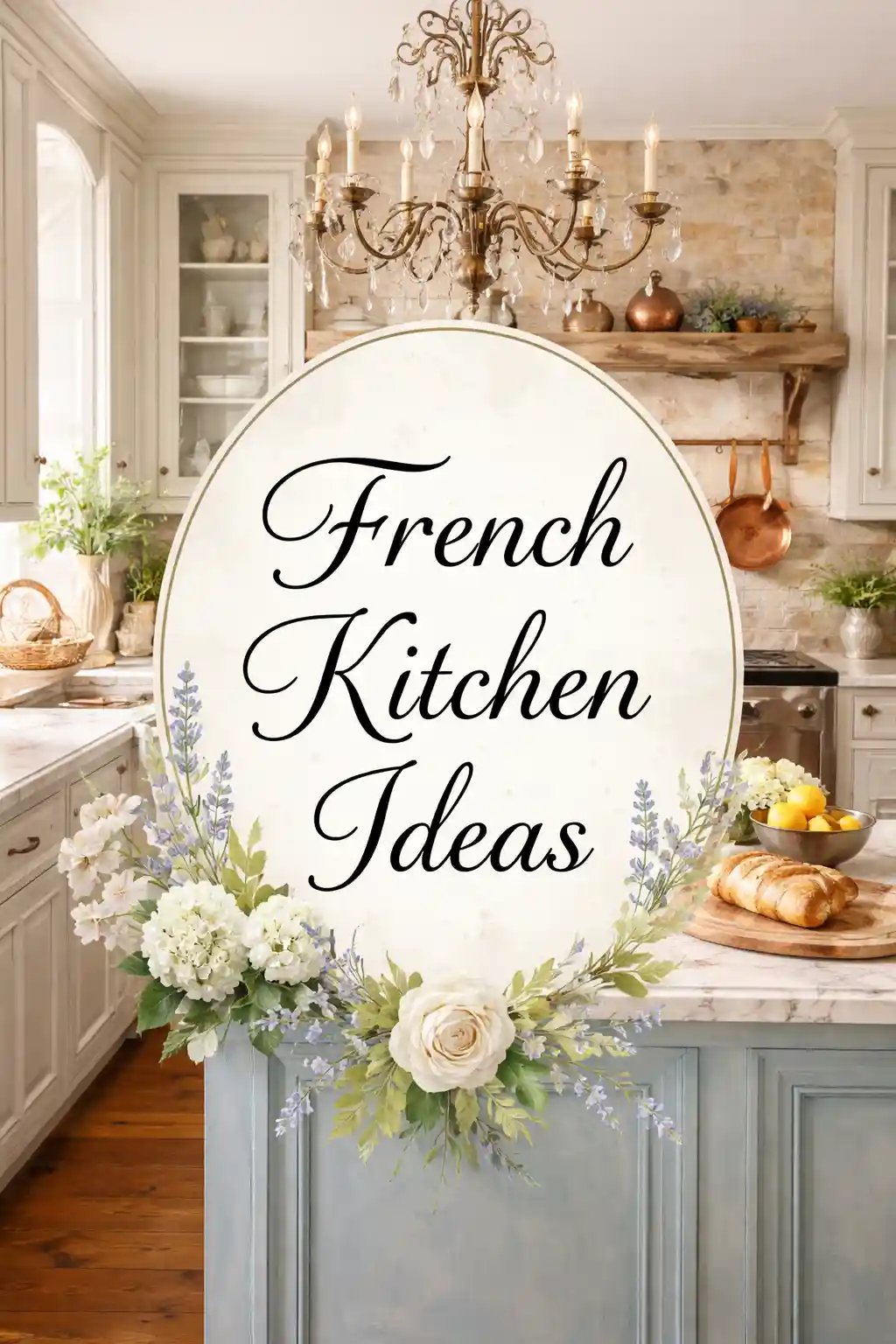
Some design styles come and go with the seasons. French kitchen design is not one of them. There’s a reason the French aesthetic has remained one of the most admired, most pinned, and most imitated kitchen styles in the world for decades it’s because it captures something genuinely rare in interior design: the perfect balance between beauty and function, between elegance and warmth, between old-world craftsmanship and everyday livability. This guide covers everything you need to know about French kitchen ideas from cabinetry and colour palettes to stone countertops, open shelving, and the small details that make all the difference.
Why French Kitchen Design Has Stood the Test of Time
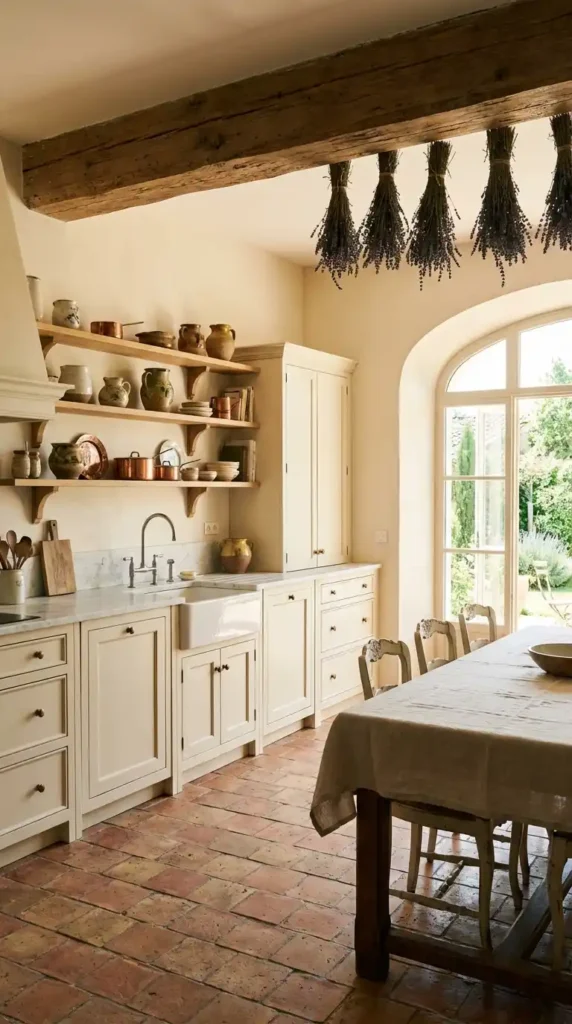
Walk into a well-designed French kitchen and something happens immediately. The room feels unhurried. It feels warm despite often being quite grand. It feels like a place where real cooking happens alongside real living where the morning bread comes out of a proper oven, where herbs grow in terracotta pots on the windowsill, where the table has been sat at by generations of the same family.
This is not accidental. French kitchen design is built around a philosophy, not just an aesthetic. The French approach to the kitchen is rooted in the belief that the kitchen is one of the most important rooms in the home a place of gathering, nourishment, and genuine pleasure. The design follows this belief. Everything in a French kitchen is chosen to support the act of cooking and living well, and because form follows function so naturally in this tradition, the result is almost always beautiful.
French kitchen ideas draw from two distinct regional traditions that are worth understanding before you start designing your own:
The Parisian Kitchen: Smaller, more refined, more architectural. Clean mouldings, marble surfaces, subtle colour palettes, and an elegance that comes from restraint rather than excess. Think Haussmann apartment with high ceilings and a kitchen that looks like it belongs in a design magazine.
The Provençal Kitchen: Larger, warmer, more rustic. Exposed stone walls, terracotta tiles, heavy wooden beams, lavender and herbs growing in abundance, and a sense that this kitchen has been feeding families for centuries. Think farmhouse in the South of France with a view of sunflower fields.
Most of the best French kitchen ideas available to contemporary homeowners draw from both traditions taking the refined elegance of Parisian design and softening it with the warmth and organic texture of Provençal style. The result is a kitchen that feels simultaneously sophisticated and genuinely livable.
The Core Principles of French Kitchen Design
Before diving into specific French kitchen ideas, it’s worth establishing the foundational principles that underpin the entire aesthetic. These principles apply whether you’re designing a large country kitchen or a compact Parisian-inspired urban space.
Also Read : Best European Kitchen Ideas That Feel Luxurious Yet Effortlessly Modern
Principle 1 — Quality Over Everything
French design philosophy prioritises quality of materials above almost all other considerations. A single piece of genuinely beautiful stone countertop is worth more than an entire kitchen of lesser materials that merely look similar. Real wood, real marble, real ceramic the French kitchen tradition values authenticity deeply, and it shows in the longevity and beauty of well-executed spaces.
This doesn’t mean a French kitchen has to be expensive. It means that within whatever budget you have, you should concentrate your spending on the materials and elements that will be seen and touched most countertops, cabinetry hardware, the sink rather than distributing it evenly across everything.
Principle 2 — Timelessness Over Trend
A French kitchen doesn’t follow trends. It ignores them. The cabinetry style, the colour palette, the hardware choices, the materials all of it is chosen to look as beautiful in thirty years as it does today. This is perhaps the most valuable principle to apply to any kitchen renovation, and it’s one the French have been practising for centuries.
When evaluating any design choice for your French kitchen, ask a simple question: will this still look right in twenty years? If the answer is uncertain, choose the more classic option.
Principle 3 — The Kitchen Is Lived In, Not Preserved
French kitchens are designed to be used. The slight wear on a wooden countertop, the patina on aged brass hardware, the gentle fading of hand-painted tiles these are not flaws in a French kitchen. They are evidence of a life well-lived in a beautiful space. This philosophy liberates you from the anxiety of maintaining perfection and allows the kitchen to develop genuine character over time.
Principle 4 — Display What Is Beautiful
The French kitchen tradition embraces open storage, hanging pot racks, and the deliberate display of cooking implements, ceramics, and ingredients as an integral part of the kitchen’s visual identity. A row of copper pots hanging from a ceiling rack is both practical and beautiful. A collection of vintage Quimper pottery arranged on open shelves is functional storage and art simultaneously. This integration of the practical and the beautiful is one of the most distinctive and appealing aspects of French kitchen ideas.
Principle 5 — The Table Matters
In a French kitchen, the table is not an afterthought. It’s a central element. Whether it’s a long farmhouse table that seats twelve or a small bistro table tucked into a corner, the dining element within or adjacent to the kitchen is taken seriously. The French don’t eat on their laps in front of the television they eat together at a proper table, and the kitchen is designed to accommodate and celebrate this.
Also Read : Two Tone Kitchen Cabinet Ideas A Complete Guide to Designing a Stylish and Functional Kitchen
French Kitchen Colour Palettes — Choosing the Right Tones
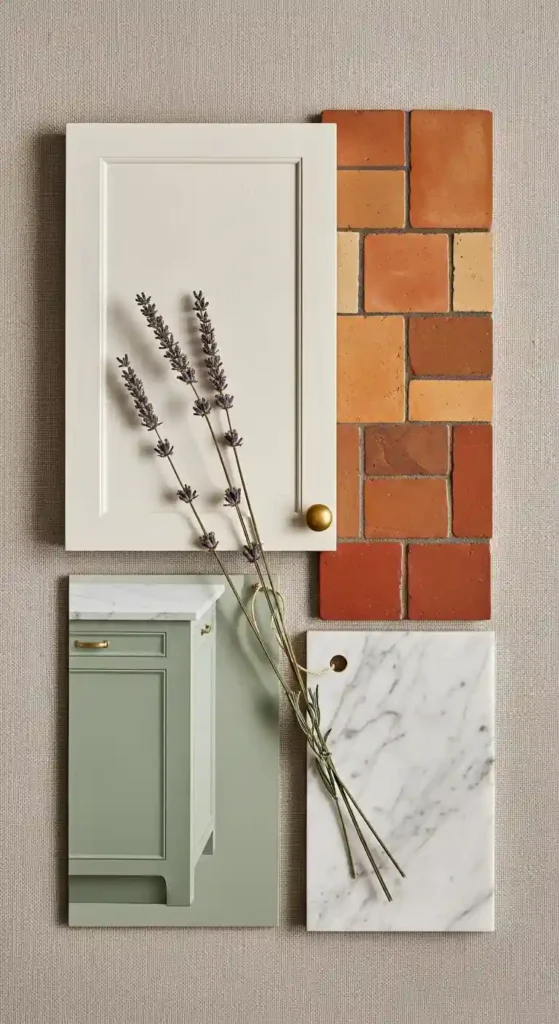
Colour is one of the most immediately impactful decisions in any kitchen design, and French kitchen ideas have a distinctive approach to colour that sets them apart from contemporary minimal kitchens and from other traditional styles.
The Classic Neutral Palette
The most quintessentially French kitchen colour palette is built on warm, soft neutrals — cream, ivory, warm white, aged linen, and pale stone. These are the colours of natural limestone, of aged plaster, of the butter and cream that define French cooking. They are almost universally beautiful, timelessly appropriate, and extraordinarily forgiving in different lighting conditions.
Best neutral choices for French kitchens:
- Farrow & Ball All White or Strong White: Creamy, warm, never cold or clinical
- Farrow & Ball Bone or Elephant’s Breath: Warm greige tones perfect for cabinetry
- Little Greene Slaked Lime or Portland Stone: Pale stone tones that feel genuinely architectural
- Dulux Almond White or Natural Calico: Accessible, warm, and reliable
A fully neutral French kitchen colour palette works because the materials the marble, the terracotta, the wood, the copper provide all the visual interest needed. The neutral background lets these materials breathe and be appreciated.
Provençal Colour Accents
While neutrals dominate, the Provençal tradition brings in colours drawn directly from the landscape of the South of France. These are used as accents on a feature wall, in tiled splashbacks, in painted cabinetry in a secondary kitchen island or dresser unit.
Classic Provençal accent colours:
- Lavender and soft violet: The most immediately Provençal choice beautiful and distinctive
- Sage and olive green: Earthy, botanical, deeply French country
- Soft terracotta and burnt sienna: Warm earth tones that echo the clay tiles underfoot
- Dusty cornflower blue: The blue of French shutters and Limoges porcelain
The key with Provençal accents in a contemporary kitchen is restraint. One or two accent colours in a predominantly neutral palette reads as sophisticated. Five different accent colours reads as chaotic.
Parisian Grey and Charcoal
For a more urban, architecturally-influenced French kitchen, grey tones from soft dove grey to deep charcoal create a refined, slightly moody palette that works exceptionally well with marble, polished brass, and dark hardwood floors.
Parisian grey kitchens feel simultaneously classic and contemporary one of the most versatile palettes available in French kitchen design. The key is warmth: choose greys with a slight green, blue, or violet undertone rather than cold, purely neutral greys that can feel clinical.
Painted Cabinetry — The French Approach
Unlike the ubiquitous grey and white shaker cabinets of contemporary kitchen design, truly French painted cabinetry has a quality and character that goes beyond a simple colour choice. Traditionally, French kitchen cabinets were painted with slightly chalky, slightly muted, almost imperfect finishes that gave them a hand-crafted quality very different from modern high-gloss painted cabinets.
To achieve this in a contemporary kitchen, look for:
- Chalk paint or mineral paint finishes rather than modern eggshell or satin
- Hand-painted rather than spray-painted where possible, for slight variation in surface texture
- Aged and distressed techniques at edges and corners to suggest genuine history
- Wax or oil finishes rather than hard lacquer — slightly less durable but far more beautiful
French Kitchen Cabinetry — The Furniture-Style Approach
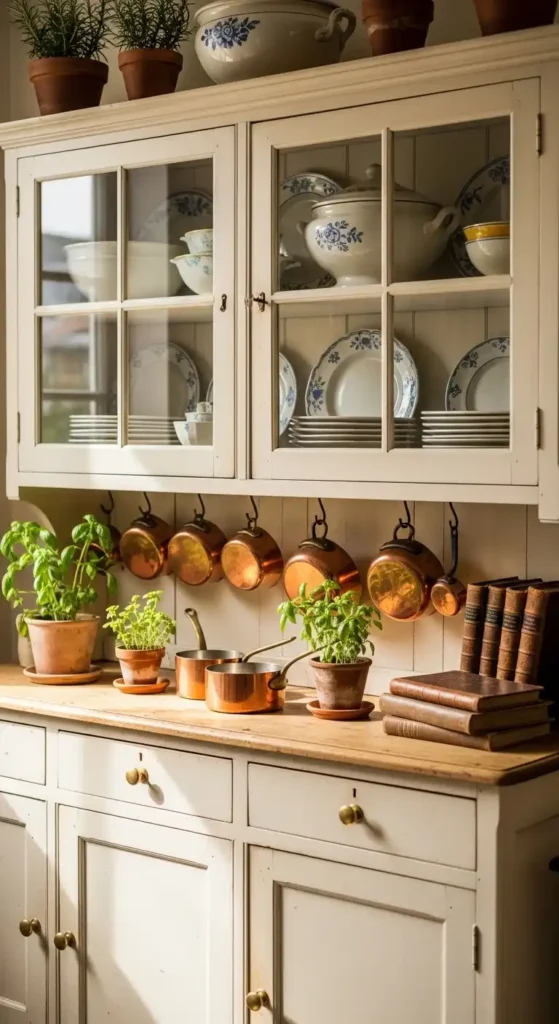
Perhaps the single most distinctive element of French kitchen ideas compared to contemporary kitchen design is the approach to cabinetry. Where modern kitchens tend toward seamless, handleless, built-in units that read as a single continuous surface, French kitchens treat their cabinetry as furniture individual pieces with character, moulding, and a sense of having been chosen and placed rather than installed.
Furniture-Style Kitchen Units
The furniture-style approach means that your kitchen cabinets look like they’ve been curated rather than fitted. This is achieved through several techniques:
Freestanding pieces mixed with built-in units: A large armoire used as a larder, a vintage dresser used as a base cabinet, a standalone butcher’s block island that can be moved these freestanding elements break the monotony of continuous runs of identical fitted units and give the kitchen a genuinely collected, lived-in quality.
Varied unit heights: Rather than all wall cabinets sitting at a uniform height, French kitchens often mix units of different heights, stack different pieces, and allow deliberate variation in the horizon line of the cabinetry.
Architectural detailing: Proper cornice mouldings at the top of tall cabinets, plinth mouldings at the base, bead-and-reel or egg-and-dart detailing on door frames these architectural touches transform flat cabinet doors into something that genuinely resembles fine furniture.
Glass-fronted cabinets: Rather than solid doors throughout, French kitchen cabinetry typically includes glass-fronted sections either clear glass or period-appropriate wire mesh that display the ceramics, glassware, and ingredients within as part of the kitchen’s visual composition.
Also Read: 40 Powerful Outdoor Kitchen Ideas DIY to Create a Stunning Backyard
Door Styles for French Kitchens
Shaker style: The most versatile and widely applicable cabinet door style for French-inspired kitchens. The recessed panel and simple frame of the shaker door works in both Parisian and Provençal interpretations. Choose a shaker door with a slightly deeper, more pronounced frame for a more classical French effect.
Beaded inset doors: Doors where the frame has a beaded detail and the panel sits flush within the frame more complex than shaker, more explicitly historical, and very beautiful in a proper French country kitchen.
Plain flush doors with surface moulding: A flat panel door with applied decorative moulding creates the look of a panelled furniture door at lower cost and complexity. Works beautifully when properly executed.
Open shelving sections: No doors at all open shelves built in the same material and finish as the surrounding cabinetry. Essential in a French kitchen for practical display and visual breathing room.
The Kitchen Dresser — A French Kitchen Essential
No single piece of furniture is more French in spirit than the kitchen dresser a floor-to-ceiling unit consisting of lower enclosed storage, an open middle shelf at counter height, and upper open shelves for display. In French kitchen design, the dresser is where personality lives: where the inherited Limoges china sits alongside the olive oil brought back from Provence, where the cookbook collection is within reach, where the children’s drawings are pinned between beautiful ceramics.
If you can incorporate a dresser into your French kitchen design either by finding a vintage piece or commissioning a fitted unit that mimics its proportions it will become the room’s most loved element.
French Kitchen Countertops — Materials That Age Beautifully
In a French kitchen, countertops are not just work surfaces. They are living materials that develop character and patina over years of use. The French approach to countertop selection favours natural materials that improve or at least change beautifully with age.
Marble — The Quintessential French Kitchen Countertop
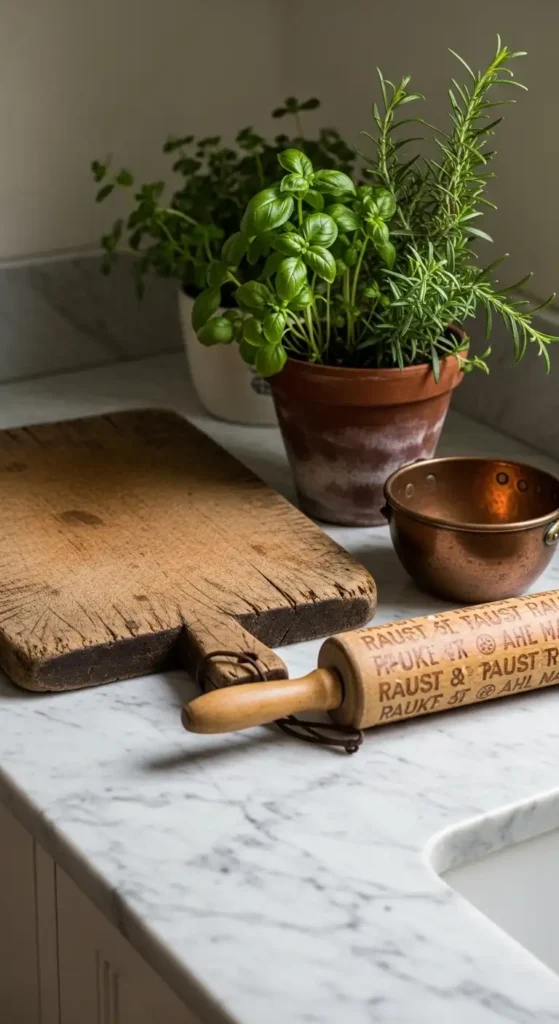
Marble is so deeply associated with French kitchen ideas that it’s almost impossible to imagine a truly French kitchen without it. The connection is historical — French cuisine has always relied heavily on pastry work, and marble’s naturally cool surface is ideal for working with butter and pastry dough. But marble has stayed because of its extraordinary beauty.
Best marble choices for French kitchens:
Calacatta marble: White background with bold grey and gold veining. Dramatic, luxurious, and unmistakably beautiful. Best for kitchens where the countertop is intended to be a statement element.
Carrara marble: White to grey background with softer, more subtle grey veining. More delicate and classic than Calacatta, and typically more affordable. The most traditional choice for French kitchen countertops.
Statuario marble: White background with strong, graphic grey veining that falls between Calacatta and Carrara in character. Striking and sophisticated.
Honed marble: Marble with a matte, slightly textured finish rather than a polished surface. This finish is more forgiving of surface marks and is more appropriate for a kitchen that’s used seriously rather than preserved.
The honest truth about marble in kitchens is that it marks, stains, and etches. The French attitude is to accept this gracefully a well-used marble countertop with years of cooking evidence is more beautiful than a pristine one that nobody dared to use properly.
Limestone and Natural Stone
Limestone countertops and work surfaces have a softer, warmer quality than marble — more matte, more earthy, and more immediately Provençal in character. They age beautifully, developing a patina that looks genuinely antique over time.
Limestone is more porous than marble and requires regular sealing, but the aesthetic reward is significant especially in a Provençal-style kitchen where the goal is warmth and natural texture above all else.
Solid Wood Countertops
Solid wood — oak, walnut, and ash being the most popular choices in French kitchen design — brings warmth, grain texture, and a sense of craft that stone cannot replicate. In the French kitchen tradition, wood is often used for the island countertop or a section adjacent to the sink, providing a warm contrast to marble or stone elsewhere.
Wood countertops require regular oiling, are susceptible to water damage around the sink if not properly sealed, and will develop knife marks, burns, and dents over time. Again — the French regard these as evidence of a life properly lived, not damage.
Reclaimed Wood and Antique Stone
For a truly authentic Provençal kitchen, reclaimed materials are the most appropriate choice. Reclaimed oak beams repurposed as countertops, antique limestone slabs salvaged from demolished buildings, hand-made tiles sourced from a French architectural salvage company these materials bring genuine history and character that no new material can replicate. They’re also increasingly sustainable choices, which adds contemporary relevance to a very traditional aesthetic.
French Kitchen Flooring — The Foundation of the Aesthetic
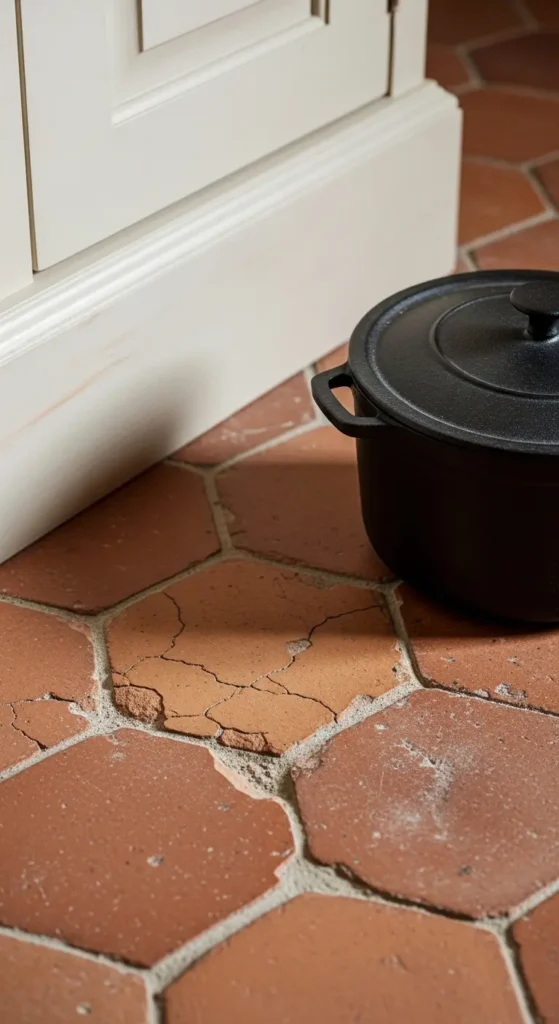
Flooring choices are the foundation of the French kitchen aesthetic — literally and visually. The wrong floor undermines everything above it; the right floor makes the whole room click into place.
Terracotta Tiles — The Provencal Classic
Handmade terracotta tiles are the most iconic flooring choice in French kitchen ideas with a Provençal influence. Their warm red-orange tones, slightly irregular surfaces, and genuine variation from tile to tile create a floor that reads as both rustic and sophisticated.
Traditional Provençal terracotta tiles are typically square format (the classic “tomette” hexagonal shape is also authentic and beautiful), unsealed or lightly oiled to maintain their natural appearance, and worn to a beautiful patina with decades of foot traffic.
For a contemporary interpretation, you can find handmade terracotta tiles from artisan makers in France, Spain, and Mexico. Machine-made terracotta is also available at lower price points, though it lacks the handmade variation that gives the floor its character.
Limestone Flags
Large format limestone flagstones the floor of choice in many genuine French country houses create a cool, pale, very grand-feeling floor that works equally well in Provençal and Parisian kitchen settings. Aged limestone flags (available from architectural salvage companies) have a particular beauty that new stone takes decades to develop.
Limestone floors feel cool underfoot in summer (a significant virtue in the South of France), are very durable, and age gracefully. They require sealing and occasional maintenance but reward the effort with extraordinary longevity and beauty.
Encaustic Cement Tiles
Patterned cement tiles the encaustic tiles so common in Moroccan and Southern European interiors are closely associated with the French kitchen aesthetic, particularly in Provence and other Southern regions with historical North African trade connections. Their geometric and floral patterns, typically in soft blue, cream, terracotta, and green, bring immediate character and a sense of place to a kitchen floor.
Used throughout the entire floor, encaustic tiles are bold and characterful. Used as a feature section in the cooking zone, as an entrance mat in front of the door, or as a splashback behind the range — they add a strong decorative note without overwhelming the space.
Aged Hardwood
Wide-plank oak floors — particularly aged or antique reclaimed oak with deep patina, knots, and character — work beautifully in French-inspired kitchens, especially in more formal Parisian settings. The warmth of aged oak complements marble countertops, cream cabinetry, and brass hardware in a way that feels genuinely elegant.
Hardwood floors in kitchens require proper sealing and some ongoing maintenance, but their warmth, acoustic quality, and beauty make them worth the effort in a kitchen designed for the long term.
The French Kitchen Sink — Where Function Meets Character
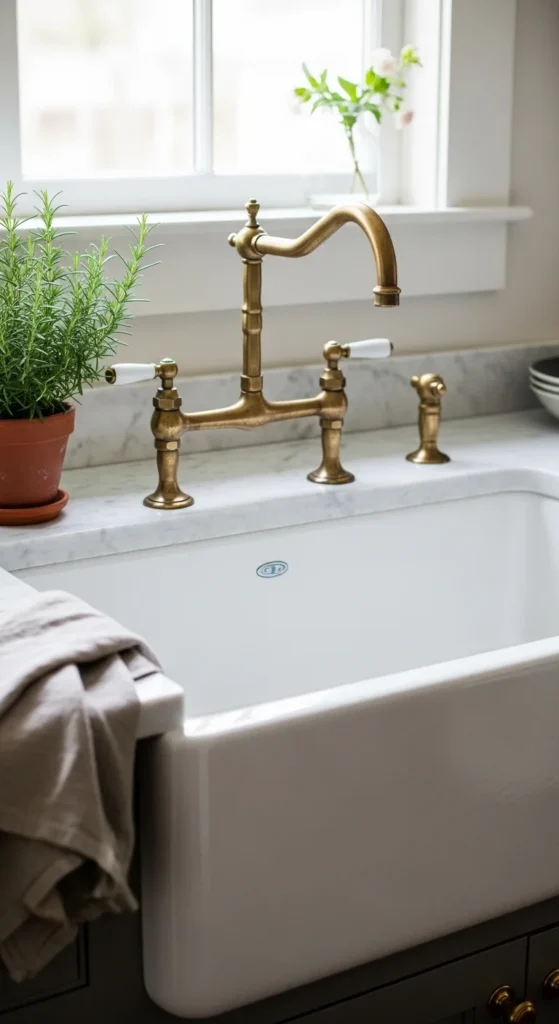
The sink is one of the hardest-working elements in any kitchen, and in a French kitchen, it’s also one of the most characterful. The French kitchen sink tradition favours generous, deep, single-basin sinks that can accommodate large pots and serious cooking — form genuinely following function.
The Farmhouse/Butler Sink
The large apron-front farmhouse sink — whether in classic white fireclay, aged stone, or burnished metal — is the most quintessentially French kitchen sink choice. Its deep, generous basin is practical for serious cooking, and its visible front panel makes it a visual statement in its own right.
White fireclay: The most classic choice. Brilliant white, very durable, chips occasionally but is largely chip-resistant in quality versions. Ages beautifully and is easy to clean.
Belfast sink: Technically British but deeply at home in French country kitchens — a deep, straight-sided white ceramic sink with a simple overflow. Practical, beautiful, enduring.
Stone sink: Carved from a single piece of limestone or granite, the stone sink is a truly extraordinary statement piece — found occasionally in genuinely historic French farmhouses and available from specialist stonecutters. Not inexpensive but completely irreplaceable.
Sink Hardware — The Importance of Getting the Tap Right
In a French kitchen, the sink tap is not a minor decision. It’s a visible, constantly-used hardware element that should be chosen with the same care as the sink itself.
Bridge taps: The two-handle bridge tap — where both handles are connected by a horizontal bar at the top — is the most classically French choice. It looks architectural, elegant, and completely at home in a traditional kitchen.
Wall-mounted taps: Even more refined, wall-mounted taps free up the sink surround entirely and have a genuinely antique quality. They work particularly well above deep farmhouse sinks.
Finishes: Aged brass, unlacquered brass, and brushed nickel are the most appropriate tap finishes for French kitchens. Avoid polished chrome — it’s too contemporary and too cold for the aesthetic.
French Kitchen Hardware — The Jewellery of the Kitchen
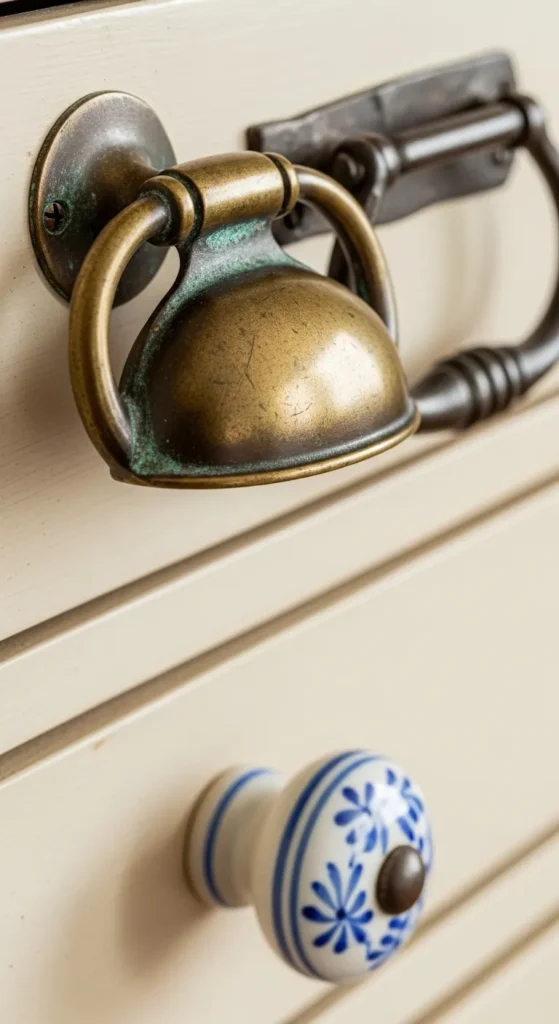
If cabinetry is the architecture of the kitchen, hardware is the jewellery. And in French kitchen design, hardware choices are taken very seriously indeed.
Brass and Bronze — The French Kitchen Hardware Standard
Aged brass and bronze are the hardware metals most closely associated with the French kitchen aesthetic. Their warm, golden tones complement cream and stone cabinetry, their slight imperfection suits the handcrafted spirit of the style, and their patina deepens beautifully over time.
Unlacquered brass: Will darken and develop patina naturally — the most authentic French approach. Requires occasional cleaning if the patina becomes too dark for your taste, but otherwise improves with age.
Aged/antique brass: Pre-finished to look already developed and warm. A more controlled, predictable choice.
Oil-rubbed bronze: Darker, more dramatic, works beautifully in kitchens with darker cabinetry or Provençal colour accents.
Hardware Styles for French Kitchens
Cup pulls: Rounded cup-shaped pulls, usually in brass or bronze, are one of the most classically French hardware choices. Simple, functional, and elegant.
Bin pulls: A horizontal bar pull in an arc shape very classic, very French, works particularly well on drawer fronts.
Ceramic knobs: White or hand-painted ceramic knobs, particularly vintage French ones, bring immediate character to a painted cabinet. Mix and match patterns and sizes for an authentically collected look.
Iron and wrought iron hardware: More rustic, more Provençal, iron hardware suits a farmhouse kitchen with stone walls and terracotta floors better than a polished Parisian setting.
Drop bail pulls: Pendant-style pulls where the handle hangs from two fixed points — architectural, elegant, and classic.
Don’t Match Everything
One of the hallmarks of genuinely well-executed French kitchen ideas in hardware selection is the deliberate avoidance of matching everything perfectly. A kitchen where every cup pull is identical, every hinge is the same, and every decorative element is from the same collection looks assembled rather than curated. The most beautiful French kitchens mix hardware styles and finishes within a consistent material family — all brass, perhaps, but different styles of pull on different cabinet types.
The French Kitchen Range — Cooking at the Heart of It All
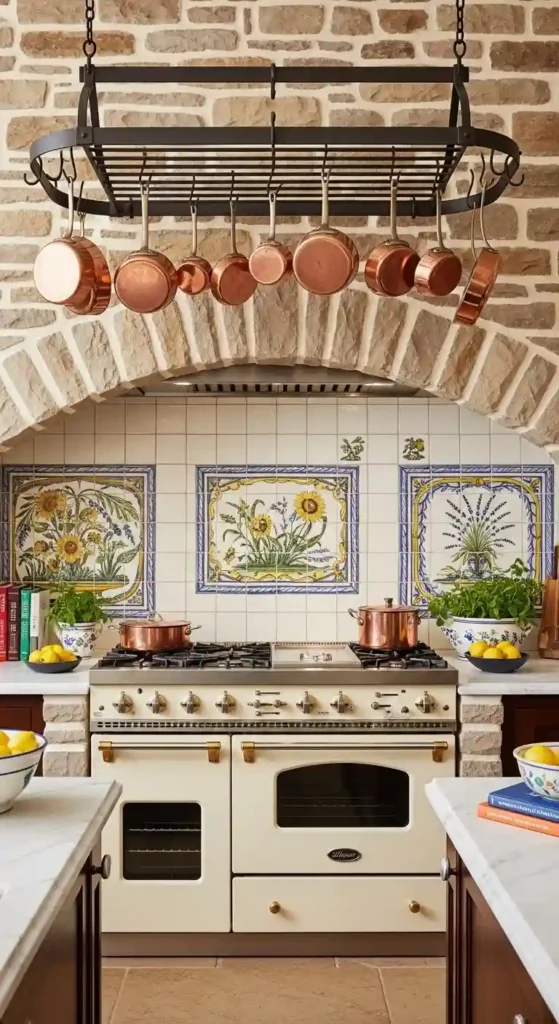
In a French kitchen, the cooking range is not hidden behind a bank of cabinetry. It is celebrated. It is the focal point of the cooking zone, often set into an architectural niche, flanked by beautifully tiled splashbacks, and treated as the statement piece it deserves to be.
The French Range Cooker
The range cooker — a large, freestanding cooker with multiple burners, a large oven, and often a secondary smaller oven or warming drawer — is the standard for a serious French kitchen. Brands like La Cornue, LACANCHE, and Godin represent the French range cooker tradition at its finest — these are extraordinarily beautiful pieces of cooking equipment that happen to be among the most capable professional-grade cookers available.
For more accessible budgets, range cookers from brands like Rangemaster, AGA, or Smeg’s Victoria series offer a similar aesthetic at significantly lower price points.
Colour choices for French range cookers:
- Cream/ivory: The classic, most versatile choice — fits any French kitchen palette
- Racing green or dark navy: A bold, sophisticated choice that makes the range a genuine centrepiece
- Cherry red or cobalt blue: Vibrant, Provençal, full of personality
- Charcoal grey: Urban, Parisian, works beautifully in a more contemporary French kitchen
The Splashback Behind the Range
The wall behind a French kitchen range is a prime opportunity for decorative expression. The most authentically French approach is a tiled splashback — either handmade terracotta tiles, hand-painted Provençal tiles in blue and cream patterns, traditional Moroccan zellige tiles in warm colours, or large format limestone tiles for a more refined look.
For a very grand, very Parisian effect, a mirrored or antique mirror splashback behind the range reflects the cooking light beautifully and creates extraordinary depth.
The Pot Rack
Hanging the pots and pans from a ceiling rack above the range or kitchen island is one of the most practically useful and visually distinctive elements of the French kitchen tradition. A proper copper pot set — whether genuine antique French copper or high-quality contemporary pieces — hanging above the range communicates immediately that this kitchen is used for serious cooking.
Ceiling pot racks in wrought iron or natural metal are available in oval, rectangular, and circular configurations. Choose a size that’s proportional to the range and the ceiling height — too small and it looks apologetic, too large and it overwhelms the space.
French Kitchen Lighting — Warmth, Layers, and Character
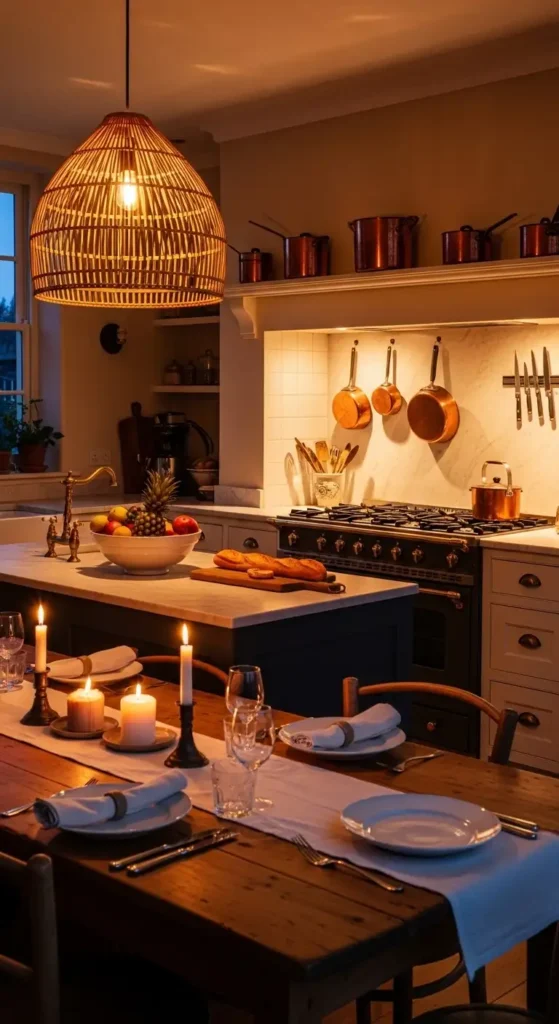
Lighting in a French kitchen is never about cold overhead fluorescence or harsh task lighting. It is about warmth, layers, and the creation of a gentle, flattering, inviting atmosphere — even in a working kitchen.
The Statement Pendant
Over a kitchen island or a dining table within the kitchen, a statement pendant light is one of the most impactful lighting decisions in a French kitchen design. The most appropriate choices for French kitchens include:
Woven rattan or wicker pendants: Organic, warm, Provençal — the light they cast has a beautiful dappled quality.
Aged brass or patinated bronze pendant shades: Classic, elegant, beautiful with marble and cream cabinetry. Emery & Cie and Vaughan Designs make extraordinary examples.
Antique French lanterns repurposed as pendants: Perhaps the most authentically French choice — an old exterior lantern with aged ironwork, converted for interior pendant use.
Ceramic pendants: Hand-thrown ceramic shades in cream, terracotta, or soft blue are a beautiful, artisanal choice for a Provençal kitchen.
Under-Cabinet Lighting
Practical and important in a seriously functional kitchen, under-cabinet lighting in a French kitchen should be as invisible as possible — the light source hidden, the effect warm and focused. Warm-toned LED strips (2700K colour temperature) provide excellent task lighting without destroying the warm atmosphere of the room.
Candles and Candlelight
It would be a very French kitchen indeed that didn’t include candlelight as part of its atmosphere. Candlesticks in brass or iron on the dining table, a collection of candles on the dresser, a lantern on the windowsill candlelight transforms a kitchen in the evening in a way no artificial light can replicate. In a French kitchen, this is not romanticism for its own sake. It is part of how the room is designed to be used.
Natural Light — Maximise It
French kitchens, particularly in country settings, traditionally benefit from generous natural light. If you’re renovating a kitchen, consider whether windows can be enlarged, whether a skylight above the cooking zone is feasible, or whether replacing a solid back door with a glazed door would meaningfully increase light levels. Natural light flatters every material in a French kitchen — the marble, the terracotta, the copper, the cream cabinetry — and no artificial lighting can fully replicate its quality.
Open Shelving and Display — The Art of the French Kitchen
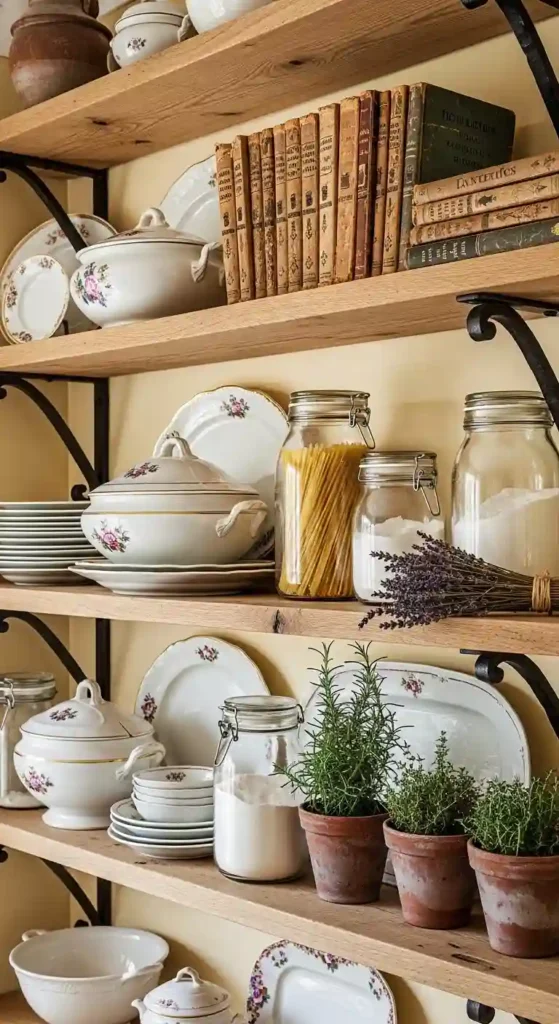
One of the most defining and beloved elements of French kitchen ideas is the approach to storage and display. The French kitchen does not hide everything behind closed doors. It curates what is beautiful and puts it on show.
What to Display on Open Shelves
Open shelving works in a French kitchen because the items displayed are genuinely beautiful — and because they’re edited with care. The secret to open shelving that looks intentional rather than cluttered is curation: only display items that contribute to the visual composition.
Classic French kitchen open shelf displays:
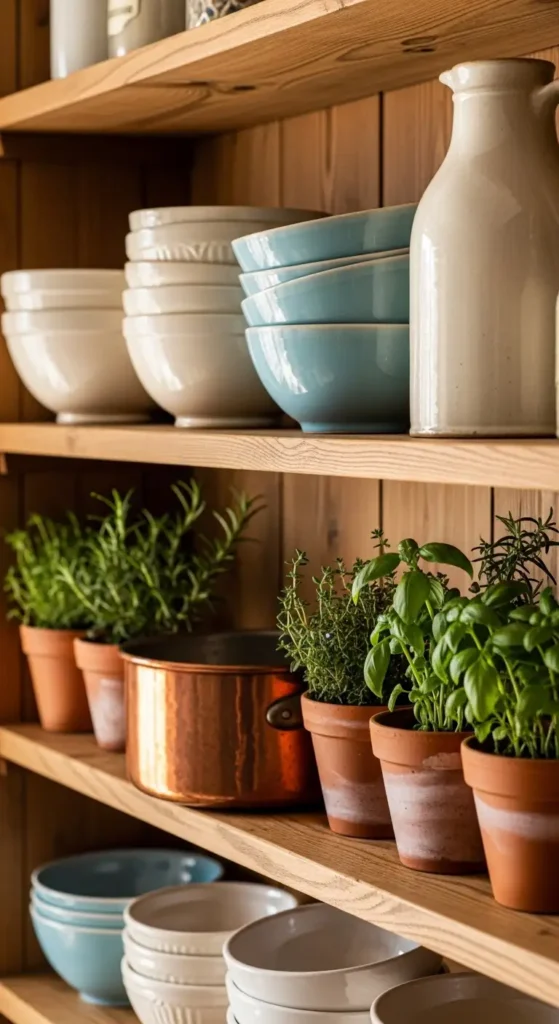
- A collection of ceramics in a limited colour family (cream, blue, terracotta)
- Vintage French storage jars and canisters labelled in French typography
- A row of cookbooks, carefully selected and arranged by height
- Fresh herbs in terracotta pots
- A collection of vintage French wine glasses
- Antique copper moulds and jelly moulds
- Bundles of dried herbs, garlic, and lavender
- A small collection of olive oils in beautiful glass bottles
The rule: if you wouldn’t be happy for a guest to see it, it goes behind a door. Everything on the open shelf should make you feel slightly pleased every time you look at it.
Shelf Materials for French Kitchens
Solid oak or reclaimed wood shelves: The most warm, organic, and texturally interesting option. Oak with visible grain, naturally aged or oiled, suits both Provençal and contemporary French kitchen settings.
Limestone or marble shelf surfaces: More formal and architectural — appropriate for Parisian-style kitchens with a more refined aesthetic.
Painted wood shelves: In the same colour as the cabinetry for a seamless look, or in a contrasting tone for a deliberate contrast. Simple, clean, and versatile.
Wrought iron brackets: The shelf brackets in a French kitchen are not hidden — they’re decorative iron scroll brackets that contribute to the overall aesthetic. Choose heavy, substantial brackets in black or aged iron rather than minimal contemporary hardware.
French Kitchen Dining — The Table as the Heart of the Room
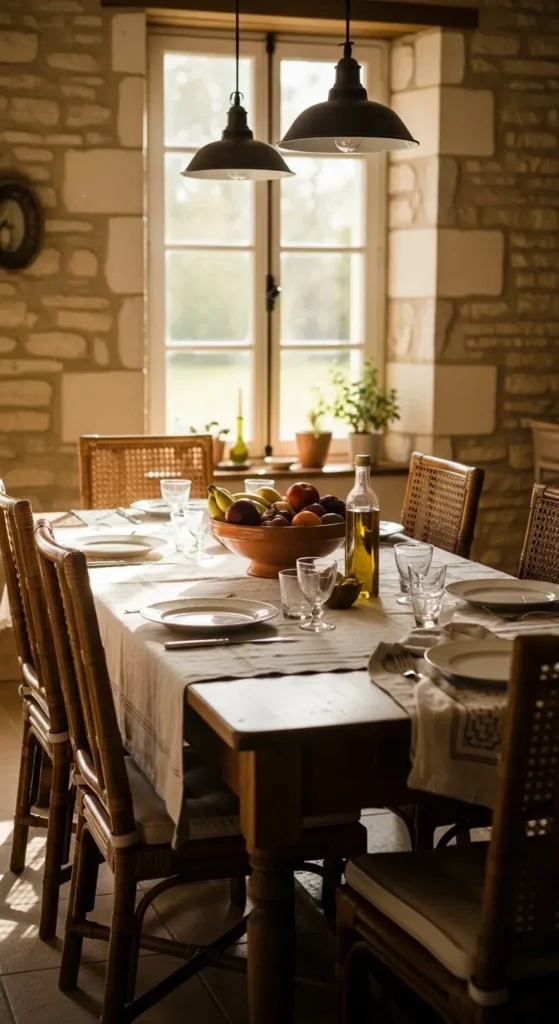
In the French kitchen tradition, the line between kitchen and dining room is deliberately blurred. The kitchen table is not in a separate room — it is within the kitchen or in an adjacent space that opens directly into it. This integration of cooking and dining is fundamental to the French approach to domestic life.
The Farmhouse Table
A long farmhouse table — ideally in aged oak with visible grain, perhaps slightly worn and marked with decades of use — is the most quintessentially French kitchen dining choice. It should seat more people than you think you’ll ever need: the French kitchen is a place of generous hospitality, and the table should reflect this.
A farmhouse table works best left as natural wood rather than painted or heavily varnished. The marks of use are part of its beauty.
The Bistro Aesthetic
For smaller kitchens, or for a secondary dining spot within a larger kitchen, the French bistro table — small, round, in zinc or marble, with slender legs — is an elegant and practical choice. A pair of classic bistro chairs in rattan or vintage woven cane completes the look.
The bistro element within a kitchen says something specific: that breakfast here is taken seriously, that a mid-afternoon coffee with a friend is a pleasure worth accommodating, that even in a busy day, there is a proper place to sit and eat.
Chairs and Seating
Rattan-back chairs: The most classically French choice — immediately recognisable from every Parisian café photograph.
Windsor chairs: More British than French but so at home in a French country kitchen that they’ve been adopted completely.
Tolix-style metal chairs: Very Parisian, very industrial, very versatile — works in both formal and casual French kitchen settings.
Benches: A bench on one side of the farmhouse table is practical for accommodating extra guests and very appropriate in a French kitchen aesthetic. A bench cushion in woven cotton or linen adds comfort.
Small French Kitchen Ideas — When Space Is Limited
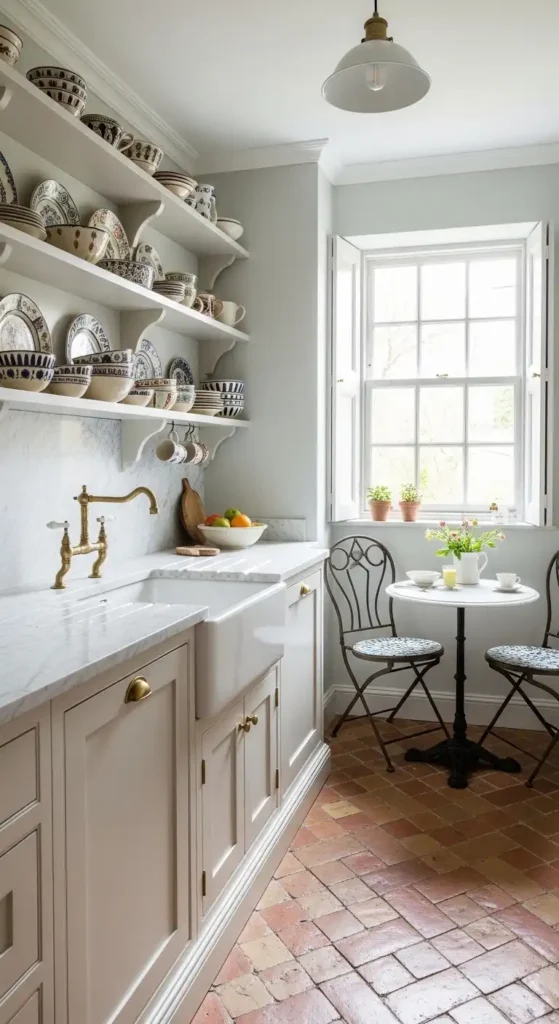
Not everyone has a large country farmhouse or a grand Parisian apartment kitchen to work with. But the French kitchen aesthetic scales beautifully — many of its most important elements can be incorporated into a small kitchen with tremendous effect.
Going Vertical
In a small kitchen, vertical space is your most valuable asset. Floor-to-ceiling cabinetry — built in the furniture style with glass-fronted upper sections — makes small kitchens feel larger and provides far more storage than standard-height units. A tall larder cabinet, treated as a standalone furniture piece, accomplishes the same goal with more character.
One Statement Material
In a small French kitchen, you cannot use every material at once without the room feeling chaotic. Choose one statement material — a marble countertop, a handmade terracotta tile floor, a hand-painted tile splashback — and let everything else be relatively simple. The single beautiful material does all the work.
Open Shelving Instead of Upper Cabinets
In a small kitchen where upper cabinets can feel oppressive, replacing some or all upper cabinets with open shelves creates an immediate sense of space and light while still providing storage and display opportunities. The visual openness of shelving — especially in a small room — is dramatically different from a solid bank of upper cabinets.
Scaled-Down Versions of Classic Elements
A small farmhouse sink rather than a large one. A two-burner antique-style range rather than a six-burner professional cooker. A pair of rattan pendants rather than a large chandelier. The French kitchen aesthetic works at every scale — the principles remain the same, the proportions adapt.
Accessories and Finishing Touches — Where the French Kitchen Comes to Life
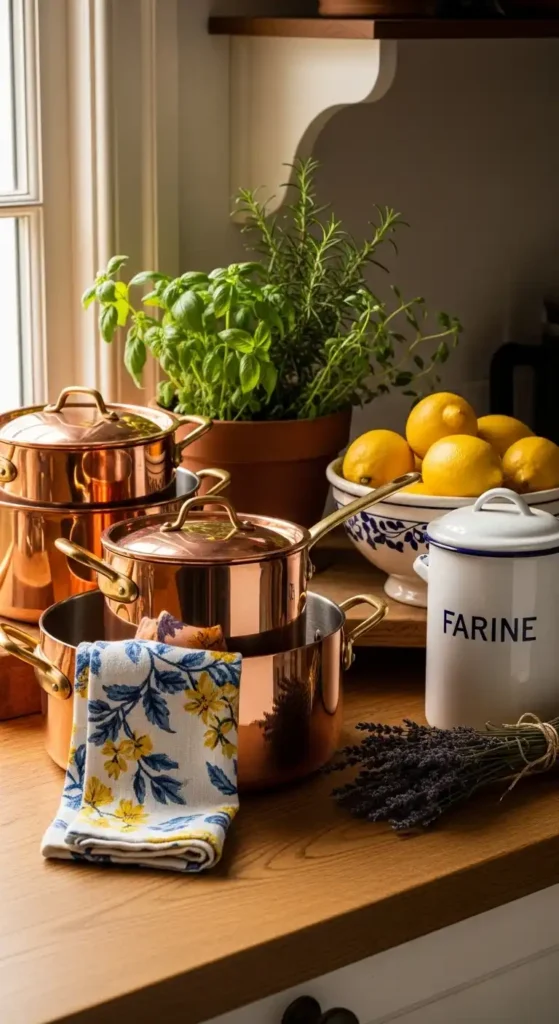
The major elements — cabinetry, countertops, flooring, lighting — create the framework. The accessories and finishing touches are what make a French kitchen feel genuinely alive and personally inhabited.
Copper Cookware
A collection of copper pots and pans is both practically excellent and visually extraordinary in a French kitchen. Copper’s warm glow against cream cabinetry or stone walls is one of the most beautiful material relationships in kitchen design. It doesn’t need to be a complete matched set — a collection assembled gradually over time, in different sizes and from different eras, is more interesting than a uniform set from a single manufacturer.
Provençal Textiles
French kitchen textiles — dish towels, tablecloths, aprons, and curtains — carry tremendous decorative weight in the French kitchen aesthetic.
Souleiado fabrics: The distinctive Provençal printed cotton fabrics from the South of France, with their intricate floral and geometric patterns in terracotta, olive, and gold, are immediately recognisable and beautiful.
Linen in natural tones: Simple, heavy, natural linen in ecru, grey-linen, or dusty blue — used for dish towels, chair cushions, and café curtains — brings texture and warmth.
Striped ticking fabric: The classic French butcher’s stripe in blue-white or red-white, used for aprons, cushions, and café curtains, is both traditional and timeless.
Fresh and Dried Botanicals
No French kitchen feels complete without growing and drying things. Fresh herbs in terracotta pots on the windowsill. Bundles of dried lavender hanging from a beam. A bowl of lemons on the counter. Rosemary sprigs in a small vase. Garlic braids hanging near the range. These botanical elements bring life, scent, and colour to the kitchen in a way that no decorative accessory can replicate — and they serve a practical purpose simultaneously.
Vintage French Kitchen Finds
The most characterful French kitchen accessories are often the ones found rather than bought new. Vintage Quimper pottery, antique French biscuit moulds hung on the wall, an old French enamel bread bin, a collection of vintage French wine labels framed simply, an antique French grocer’s scale used as a display piece — these found objects bring genuine history to the kitchen and make it feel like it has been accumulated over a lifetime rather than assembled in an afternoon.
Budgeting for Your French Kitchen — Getting the Look at Every Price Point
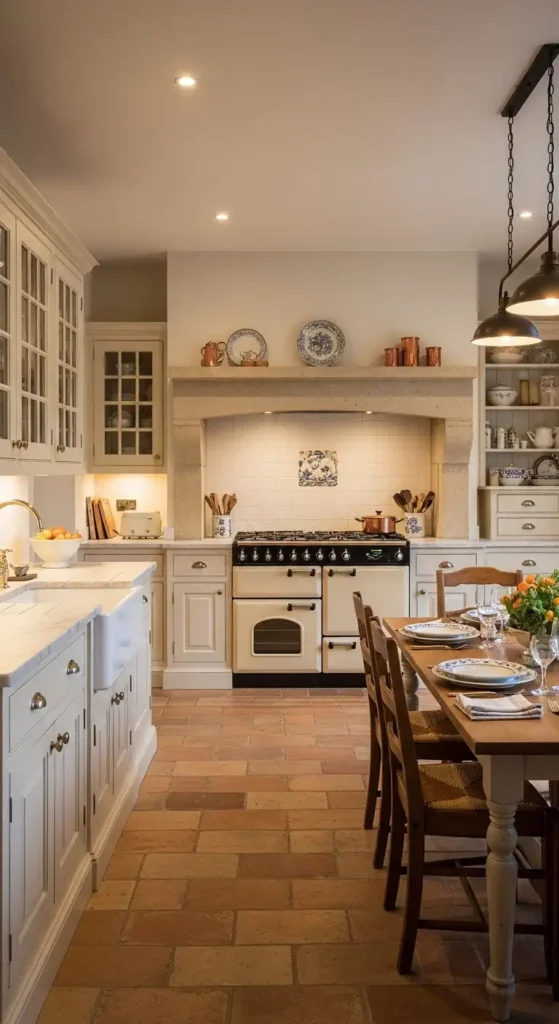
A French kitchen does not have to cost a fortune. The aesthetic is deeply rooted in quality and authenticity rather than expense, and many of its most important elements — open shelving, painted cabinetry, natural materials — are achievable at very different budget levels.
High-Impact, Lower-Cost Changes
Paint your existing cabinets: Repainting cabinet doors in a warm cream or sage green with a chalk-paint finish is one of the highest-impact, lowest-cost transformations available in kitchen renovation. Combine with new brass hardware and the transformation is remarkable.
Replace the sink: Swapping a standard stainless steel sink for a fireclay farmhouse sink is a dramatic upgrade for moderate cost.
Add open shelves: Removing upper cabinet doors and adding a shelf or two is low cost and immediately shifts the kitchen toward the French aesthetic.
Change the hardware: Replacing all existing hardware with aged brass cup pulls and ceramic knobs costs very little and changes the kitchen’s character entirely.
Add a Provençal tile splashback: Handmade tiles for a small splashback area represent relatively modest cost for significant visual impact.
Mid-Range Investment Points
At a mid-range budget, prioritise: new cabinetry (or professional cabinet repainting), a proper farmhouse sink, a quality countertop in marble or butcher’s block, and a range cooker in place of a standard oven and hob combination. These four investments create a kitchen that reads immediately as French.
The Full Investment
At the top end, a fully realised French kitchen with custom furniture-style cabinetry, hand-sourced limestone flags, a La Cornue or LACANCHE range, antique French dresser, reclaimed stone sink, and fully fitted copper pot rack is genuinely one of the most beautiful and enduring kitchen investments available. Designed and executed properly, it will outlast every trend and improve with every year of use.
Closing Thoughts
Designing a French kitchen is not merely a renovation project. It is a statement about how you want to live about the value you place on cooking well, eating together, welcoming guests, and surrounding yourself with beautiful, enduring things.
The principles of French kitchen design quality over trend, natural materials that age beautifully, the integration of function and beauty, the treatment of the kitchen as a living room rather than a utility are among the most sensible and most human-centred principles in all of interior design. They produce kitchens that are not just beautiful to look at but genuinely wonderful to live in.
Whether you’re starting from scratch with a complete renovation or gradually evolving an existing kitchen toward a more French aesthetic through paint, hardware, open shelving, and carefully chosen accessories the direction is one of the most rewarding in kitchen design. Every step in the direction of French kitchen ideas is a step toward a more beautiful and more livable home.
Start with the piece that excites you most. Let the rest follow naturally. In the French tradition, the best kitchens are never really finished they simply keep getting better.
Frequently Asked Questions
1: What defines a French kitchen style?
A French kitchen is defined by its combination of natural materials (marble, terracotta, limestone, solid wood), furniture-style cabinetry with architectural detailing, warm neutral colour palettes sometimes accented with Provençal colours, a prominent range cooker as a focal point, open shelving and display of beautiful objects, and a fundamental philosophy that the kitchen is a room for living in as well as cooking. The overall effect is simultaneously elegant and warm — refined without being cold.
2: What colours are most used in French kitchens?
The dominant colours in French kitchens are warm neutrals: cream, ivory, warm white, aged linen, and pale stone tones. Provençal-influenced kitchens introduce accents of sage green, lavender, soft terracotta, and dusty blue. Parisian kitchens favour warmer grey tones and charcoal alongside cream. Brass and bronze hardware adds warm metallic tones throughout.
3: What countertop material is most French?
Marble particularly Carrara or Calacatta marble in a honed finish is the most quintessentially French countertop material, rooted in the French pastry-making tradition. Limestone and natural stone are also deeply appropriate, as is solid oak or reclaimed wood for kitchen islands. The French favour natural materials that develop character with use over synthetic alternatives.
4: Can I achieve a French kitchen on a limited budget?
Absolutely. The most impactful budget-friendly approaches are: painting existing cabinets in a warm cream or sage with a chalk-paint finish, replacing hardware with aged brass cup pulls and ceramic knobs, adding open shelving in place of upper cabinets, introducing a terracotta-tiled splashback, and swapping a standard sink for a fireclay farmhouse sink. These changes can transform an ordinary kitchen into something with genuine French character for very moderate investment.
5: What is the difference between French country and Parisian kitchen style?
French country (Provençal) kitchens are warmer, more rustic, and more organic featuring terracotta tiles, exposed stone, heavy wooden beams, earthy colour accents, and an overall aesthetic that feels rooted in the land. Parisian kitchens are more refined, more architectural, and more formal featuring grey tones, marble, higher-gloss finishes, more restrained detailing, and an elegance associated with apartment living in a grand city. Most successful contemporary French kitchen ideas draw from both traditions.
6: Do French kitchens work in small spaces?
Yes beautifully. The key adjustments for small spaces are: using vertical space with tall cabinetry, choosing one statement material rather than many, replacing upper cabinets with open shelving to preserve lightness, and scaling down classic elements (smaller farmhouse sink, smaller range, small bistro table). The core aesthetic principles apply fully regardless of room size.
7: What type of sink is best for a French kitchen?
A large, deep, single-basin farmhouse sink in white fireclay is the most classically French choice. Belfast sinks are closely related and equally appropriate. Stone sinks carved from a single piece of limestone or granite are the most extraordinary option for those with budget for them. The tap should be in aged or unlacquered brass, ideally in a bridge or wall-mounted style.
8: What flooring best suits a French kitchen?
Handmade terracotta tiles (particularly hexagonal tomette tiles) are the most Provençal choice. Antique limestone flags are the most grand and classical choice. Encaustic patterned cement tiles offer decorative interest and are historically appropriate in Southern French settings. Wide-plank aged hardwood oak works beautifully in more formal or Parisian-style kitchens. All these options share the quality of aging and developing character over time.
9: What lighting should I use in a French kitchen?
Layer your lighting: a statement pendant over the island or dining table in woven rattan, aged brass, or ceramic; warm under-cabinet LED strips (2700K) for task lighting; and candles or candlelight for atmosphere in the evenings. Maximise natural light wherever possible. Avoid cool-toned overhead fluorescent or LED lighting it destroys the warm atmosphere that is fundamental to the French kitchen aesthetic.
10: Which range cooker brands are most associated with French kitchens?
La Cornue and LACANCHE are the iconic French range cooker brands — both extraordinary pieces of engineering and craftsmanship at the luxury end of the market. For more accessible budgets, Rangemaster, Smeg’s Victoria series, and Bertazzoni’s Heritage series offer excellent quality and appropriate aesthetics. AGA cookers, while British in origin, have a warmth and permanence that suits the French country kitchen tradition very well.
11: How do I incorporate copper into a French kitchen?
The most effective ways to incorporate copper are: a hanging pot rack above the range or island with copper pots and pans; a copper farmhouse sink (rare but extraordinarily beautiful); copper measuring cups, mixing bowls, and kitchen tools displayed on open shelves; and copper accents in pendant lighting. Copper’s warmth and glow against cream cabinetry and marble or stone is one of the most beautiful material relationships in kitchen design.
12: What hardware finishes work best in French kitchens?
Aged brass, unlacquered brass, oil-rubbed bronze, and wrought iron are the most appropriate hardware finishes for French kitchens. Unlacquered brass that develops natural patina over time is the most authentic choice. Avoid polished chrome or contemporary matte black — these finishes are too modern and too cold for the aesthetic.
13: What open shelving items should I display in a French kitchen?
Display items that are beautiful, practical, and personal: a collection of ceramics in a limited colour family, vintage French storage jars, cookbooks arranged by height, fresh herbs in terracotta pots, copper cookware, dried lavender and botanicals, vintage wine glasses, and any antique French kitchen finds with personal meaning. The rule is simple: only display what you find genuinely beautiful.
14: Can a French kitchen work in a modern home?
Yes and it often works extraordinarily well in a modern home precisely because it provides such warmth, character, and material richness as a contrast to contemporary architecture. The key is ensuring the French kitchen elements are executed with genuine quality and care, rather than as superficial applied decoration. A truly French kitchen in a contemporary setting creates a tension that feels sophisticated and intentional rather than confused.
15: How long does a well-designed French kitchen last?
A properly designed and built French kitchen using natural materials, quality cabinetry construction, and the timeless aesthetic principles of the French tradition should last indefinitely. Unlike trend-driven kitchen designs that look dated within five to ten years, the French kitchen aesthetic has been beautiful for centuries and shows no sign of changing. With proper maintenance, a quality French kitchen will look better at thirty years than it did on the day it was completed.