
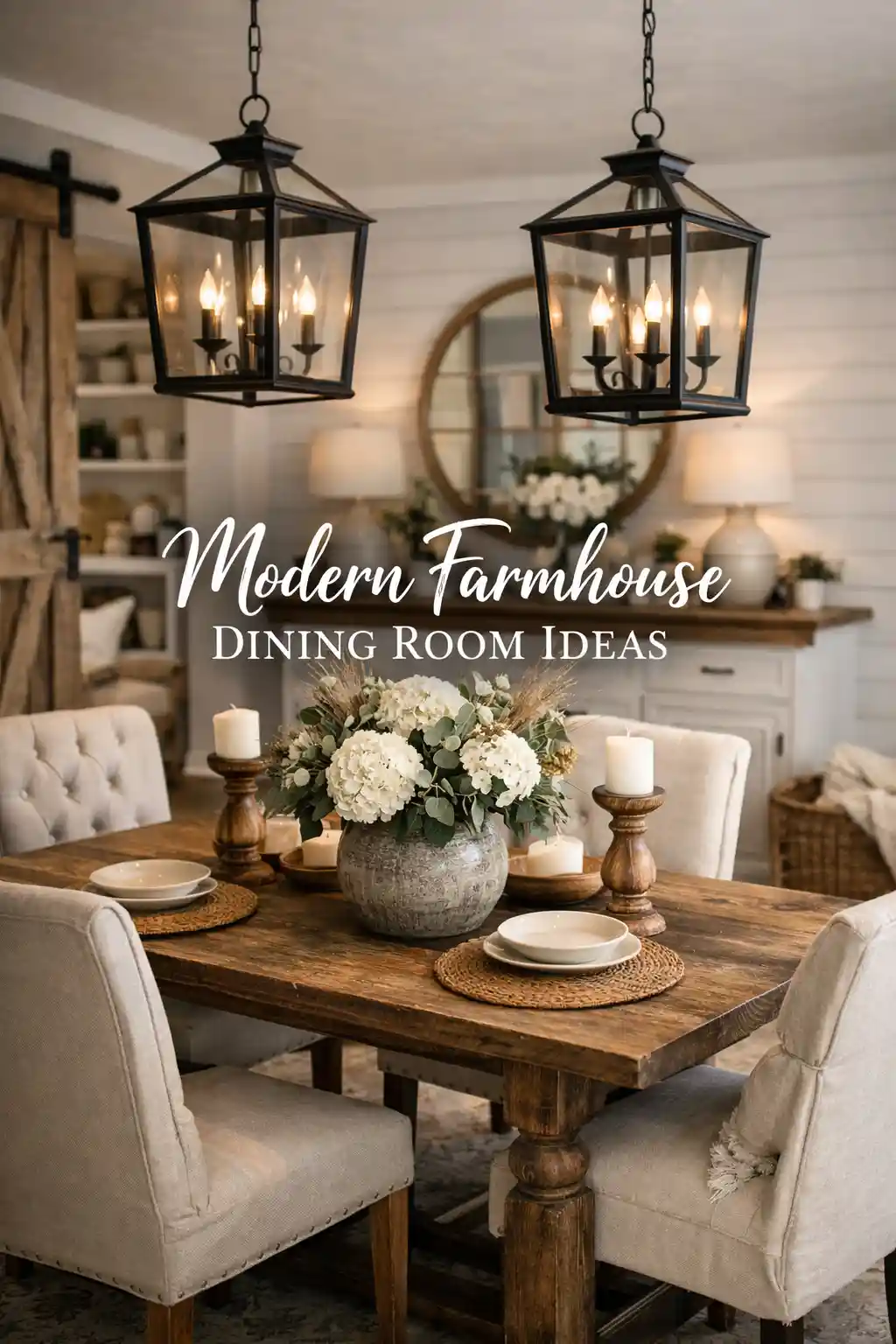
Let me be honest with you. I have spent years flipping through design magazines,
pinning ideas on boards I never look at again, and walking into showrooms that made
everything look impossibly perfect. And for a long time, when I tried to bring any of that
home, something always felt off. Too stiff. Too expensive-looking. Too much like a hotel
and not enough like a place where your kids could actually spill their orange juice
without causing a crisis.
Then I found modern farmhouse dining room ideas not the Pinterest-perfect,
everything-matches, looks-like-a-catalog version, but the real, lived-in, layered version.
The kind of space where a dented wooden table feels intentional, where mismatched
chairs look curated instead of chaotic, and where the whole room somehow manages to
feel warm and welcoming even on a random Tuesday night.
That’s what this guide is really about. I’ve pulled together 50 modern farmhouse dining
room ideas that go well beyond the basics ideas that work in actual homes with real
budgets, varying ceiling heights, awkward layouts, and families who need a space to
function as well as look good. Whether you’re starting fresh or just trying to breathe new
life into what you already have, there’s something here for you.
The modern farmhouse aesthetic has staying power for a reason. It isn’t a trend that will
look dated in three years. It’s a philosophy about how a space should feel rooted,
honest, comfortable, and beautiful in a quietly confident way. And when you get it right
in your dining room, you’ll find yourself lingering at the table long after the meal is
done.
What Exactly Makes a Dining Room ‘Modern Farmhouse’?
Before we dive into specific ideas, I think it’s worth taking a moment to understand what
modern farmhouse dining room design actually means because there’s a lot of
confusion out there, and a lot of spaces that call themselves farmhouse but are really
just rustic, or just modern, without that magical middle ground.
The modern farmhouse look is defined by tension. It’s the tension between old and new,
rough and refined, simple and layered. You have the warmth and texture of farmhouse
elements reclaimed wood, linen, woven baskets, galvanized metal, shiplap paired
with the clean lines and restraint of modern design. Neither side dominates. They push
and pull against each other in a way that makes the room feel dynamic and alive without
ever feeling chaotic.
In a modern farmhouse dining room specifically, this tension usually shows up in a few
key ways: a substantial wooden table paired with sleek, contemporary chairs; exposed
ceiling beams above a modern pendant light fixture; a neutral color palette warmed up
by natural textures; and accessories that feel personal rather than purchased-as-a-set.
It’s intentional without being rigid.
Quick definition: Modern farmhouse = rustic warmth + contemporary restraint. If your
dining room feels too country-cute or too cold and minimal, you’re off-balance. The sweet
spot is both at once.
Start With the Table — It’s the Whole Point

For a true modern farmhouse look, you want a table that has genuine presence. That
doesn’t necessarily mean huge — it means substantial. A thick solid wood top, whether reclaimed or new, gives you that grounded, rooted quality that defines this aesthetic.
Look for visible grain, natural variation in the wood tone, and a surface that looks like it
has a history even if it doesn’t.
The shape matters too. Long and rectangular is the classic farmhouse choice — it’s
communal, it encourages everyone to face each other across the width of the table, and it
scales beautifully in most dining room proportions. Trestle legs have a wonderful
simplicity that reads as both traditional and modern. Pedestal bases work well if you
need flexibility with seating arrangements.
Shopping tip: Don’t be afraid of a table that has imperfections. Knots, grain variation, a
small crack that’s been filled — these things are features, not flaws. They give the table life
and authenticity that no perfectly smooth surface can match.
Pair the natural wood top with darker or contrasting legs if you want to lean into the
modern side of the aesthetic. Black metal trestle legs, deep walnut pedestals, or even
painted white legs create a visual contrast that keeps the table feeling current rather
than purely rustic.
Also Read : 100 Designer Approved Dining Room Ideas Stylish Functional Spaces to Transform your home
The Shiplap Wall Moment — Yes, It Still Works

I know, I know. You’ve seen shiplap everywhere. Joanna Gaines essentially made it a
household word, and for a while there it felt like every flip show and design blog was
plastering the stuff on every wall in every house. But here’s the thing — there’s a reason
shiplap became so ubiquitous in modern farmhouse dining room design. It genuinely
works.
The horizontal lines of shiplap add texture and visual interest without adding color or
pattern complexity. It’s a textural neutral — it enriches a wall without competing with
anything else in the room. When you paint it the same white or soft off-white as the rest
of your walls, it becomes a subtle architectural detail that makes the room feel more
finished and intentional than drywall alone ever could.
In a dining room specifically, a shiplap accent wall behind a sideboard or credenza is
one of the smartest modern farmhouse moves you can make. It creates a natural
backdrop for the furniture piece and any art or accessories you style above it, framing
that wall as a considered composition rather than just a surface with stuff on it.
If you’re renting or not ready to commit to the real thing, peel-and-stick shiplap panels
have gotten remarkably good. They won’t fool a professional, but they’ll fool your dinner
guests which is all that matters.
You can also subvert the all-white approach entirely. Shiplap painted in a moody sage
green, a warm greige, or even a deep navy creates a dramatically different but equally
compelling effect. The texture remains the point the color just shifts the mood.
Lighting That Does the Heavy Lifting

The chandelier or pendant above your dining table serves two equally important
functions: it provides the primary illumination for the space, and it acts as a piece of
functional sculpture that defines the visual character of the entire room. In a modern
farmhouse dining room, you want a fixture that earns its place on both counts.
The wagon wheel chandelier has become almost synonymous with modern farmhouse
dining room style, and for good reason. When scaled correctly — and this is the key
point that most people miss it’s genuinely spectacular. Go big. A wagon wheel
chandelier above a dining table needs to be substantial enough to feel intentional, not
like an afterthought. Aim for a diameter that’s roughly half to two-thirds the width of
your table.
Beyond the wagon wheel, there are plenty of other lighting directions that work
beautifully in this aesthetic. Black iron pendant clusters with exposed Edison bulbs
bring an industrial edge that reads as modern without abandoning the farmhouse spirit.
Rattan or woven pendant shades add warmth and organic texture. Lantern-style fixtures
in aged brass or matte black split the difference between traditional and contemporary
in a satisfying way.
Dimmer switch tip: Whatever fixture you choose, always, always put it on a dimmer. A
dining room that can go from bright and practical for Sunday morning pancakes to warm
and intimate for Saturday night dinner is worth its weight in gold.
Mix Your Seating — Don’t Match Everything

The beauty of this aesthetic is that it rewards the mix. A long trestle table looks
spectacular with different seating types on each side: a solid wood bench on one side
(ideal for kids and casual meals, plus it tucks neatly under the table when not in use),
and individual chairs on the other. At the heads of the table, two upholstered armchairs
in a linen or textured fabric add a layer of comfort and a subtle sense of ceremony that
wooden side chairs can’t provide.
The secret to making mixed seating look intentional rather than accidental is to
maintain one connecting thread across all the pieces. That might be a consistent color —
all the chairs in white or natural wood, for instance. Or a consistent material — all wood,
regardless of style. Or a consistent era — all mid-century or all traditional farmhouse
shapes, mixed in terms of specific design but unified in their general aesthetic family.
Wishbone chairs are a particular favorite of mine for modern farmhouse dining rooms.
They have that wonderful quality of feeling simultaneously contemporary and classic,
and their organic curved form plays beautifully against the more angular lines of a
farmhouse table. They’re lightweight, stackable, and endlessly photogenic which
doesn’t hurt.
Exposed Ceiling Beams — The Architectural Gift

If your home has original timber ceiling beams in the dining room, consider yourself
lucky in a way that no amount of careful decorating can replicate. Exposed beams carry
something that faux alternatives can’t fully capture — a sense of structural honesty, of a
building that isn’t hiding what it’s made of. In a modern farmhouse dining room, that
honesty is part of the entire philosophy.
That said, faux beams have gotten genuinely good. High-density polyurethane beams
that look like real wood from any normal viewing distance are widely available,
relatively affordable, and can be installed as a DIY project on a weekend. If your dining
room has a flat drywall ceiling and you’ve been dreaming of beams, this is a very
achievable upgrade.
The finish of your beams is worth thinking about carefully. Natural, unstained wood
beams read as casual and organic. Dark walnut or espresso-stained beams create a
dramatic contrast against a white ceiling and tend to lean more toward the modern end
of the farmhouse spectrum. Whitewashed or weathered grey beams soften the look and
feel more coastal-farmhouse or Scandinavian-adjacent. All of these can work beautifully the choice depends on the overall direction you’re taking the room.
If you have low ceilings under 8 feet skip the beams entirely. Beams in a low-
ceilinged room will make the space feel compressed rather than dramatic. In a higher-
ceilinged room, they’re transformative.
The Color Palette — Neutral But Never Boring

When most people think about modern farmhouse dining room color palettes, they
picture white. And yes, white is central to this aesthetic — but it’s rarely the only color,
and the whites themselves are rarely the harsh, cool, blue-tinted white of a hospital
corridor. Farmhouse whites are warm. They have a slight creaminess or greige
undertone that makes them feel soft and enveloping rather than stark.
Building from that warm white base, the modern farmhouse palette layers in natural
wood tones (which read as their own version of color — warm honey, deep walnut,
weathered grey), black or near-black accents through metal fixtures and furniture
details, and soft textural naturals through linen, cotton, jute, and rattan. This
combination alone — white, wood, black, natural fiber — is sufficient to create a
complete and sophisticated dining room palette.
Where it gets interesting is when you introduce a real color. Sage green is having an
enormous moment in modern farmhouse dining rooms right now, and it deserves every
bit of that attention. As an accent wall color, a cabinet color, or even a trim color, sage
brings the botanical quality of the outdoors inside in a way that feels completely
authentic to the farmhouse spirit. It pairs with warm wood tones beautifully and doesn’t
compete with natural light the way darker or more saturated colors can.
Other colors that work exceptionally well in modern farmhouse dining rooms: dusty
blue-grey (think classic Swedish farmhouse), terracotta and clay tones (warmer and
more bohemian-adjacent but still firmly in the farmhouse family), and deep charcoal or
near-black for bold, moody interpretations that feel sophisticated and contemporary
while still honoring the core material palette.
Paint tip: Always test your wall colors in the actual room at different times of day before
committing. Dining rooms are often used primarily in the evening under artificial light,
which can shift warm colors dramatically. What looks perfect in afternoon sunlight may
feel orange or muddy after dark.
Flooring That Grounds the Whole Room

Flooring in a modern farmhouse dining room is one of those decisions that you live with
for decades — which means it’s worth getting right, and it’s also worth understanding
that you can make almost any flooring situation work with the right approach.
The ideal modern farmhouse dining room floor is wide-plank hardwood in a warm,
natural tone with a matte or satin finish. Wide planks anything over 5 inches
immediately read as more farmhouse-appropriate than narrow strip flooring, which
tends to feel more formal and traditional. The width of the planks gives the floor a
generous, unhurried quality that pairs naturally with the scale of farmhouse furniture.
If your dining room has existing flooring that isn’t your dream scenario tile, laminate,
narrow hardwood strips the single most effective solution is an area rug. A natural
fiber rug in jute, sisal, or seagrass laid under the dining table creates a visual grounding
for the seating area while adding texture that no other flooring treatment can match.
Size matters here: go larger than you think you need, with a rug that extends at least 24
inches beyond the perimeter of the table so that chairs remain on the rug when pulled
out. Nothing makes a dining room rug look worse than chairs falling off the edge.
Concrete floors either original poured concrete or large concrete-look porcelain tile
are another option that has found a genuine home in modern farmhouse dining room
design, particularly in spaces with an industrial edge. Softened with a large rug and
warm lighting, concrete floors can feel unexpectedly warm and sophisticated while
reinforcing the honest-materials philosophy at the heart of this aesthetic.
Windows, Natural Light, and Black Frames

In a modern farmhouse dining room, natural light isn’t just nice to have it’s a core
design element. The whole aesthetic depends on the warmth and quality of natural light
interacting with natural materials. A dining room that doesn’t get much natural light is
working against the farmhouse spirit at a fundamental level.
If you have the opportunity to renovate or you’re planning a new build, prioritize large
windows in the dining room. Floor-to-ceiling windows, French doors that open onto a
patio or garden, or even a bank of smaller divided-light windows are all beautiful in a
modern farmhouse context. The key is to let the outside in to create that feeling of
connection between the interior and the landscape that makes farmhouse homes feel so
grounded.
The trend toward black-framed windows has been one of the most significant moves in
modern farmhouse dining room design over the past decade, and it shows no sign of
slowing down. Black window frames read as a modern touch they’re crisp, graphic,
and contemporary while the large glass panes they surround maintain the farmhouse
connection to nature and light. The combination of black metal frames and white walls
is one of those visual tensions I mentioned earlier: it’s modernizing without abandoning
warmth.
For window treatments in a modern farmhouse dining room, restraint is usually the
right call. Simple linen panels in a natural, undyed linen or a very soft white are the
most versatile and timeless choice. They add softness and a layer of privacy when
needed while maintaining the light, airy quality that defines the aesthetic. Avoid heavy
drapes or blackout curtains unless your dining room genuinely needs light control for a
specific functional reason — they tend to weigh the space down.
The Sideboard or Buffet — Function Meets Farmhouse

A great dining room needs storage for table linens, extra serving pieces, candles, wine,
and all the other things that make hosting a dinner feel effortless rather than chaotic. I
a modern farmhouse dining room, that storage comes in the form of a sideboard, buffet,
or credenza, and it should be chosen with the same care as the dining table itself.
The farmhouse sideboard is typically a long, low piece 54 to 72 inches wide, with a
combination of drawers and cabinet doors. The finish should complement the dining
table without necessarily matching it. A natural wood table pairs beautifully with a
painted sideboard in white or cream or even a moody dark green or navy if you want
to introduce a richer color. A white-painted table might call for a natural wood
sideboard to maintain the warm-cold, wood-painted tension that runs through this
aesthetic.
What you put on top of the sideboard matters just as much as the piece itself. This is
where your styling instincts come into play. A large ceramic vase with dried pampas
grass or fresh branches, a simple stack of books, a pair of candle holders in varying
heights, a small potted plant, a ceramic bowl filled with seasonal fruit these are the
kinds of objects that feel authentically farmhouse without looking curated to the point of
sterility.
Above the sideboard, a gallery wall of framed botanical prints or vintage illustrations is a
classic farmhouse move that works every time. Keep the frames consistent (all black, all
white, or all natural wood) but let the art itself vary in size and composition. The
consistency of the frames holds the grouping together while the variation keeps it feeling
collected rather than purchased.
Centerpiece Ideas That Actually Work for Daily Life

I want to talk about centerpieces for a minute, because I see so many modern farmhouse
dining rooms fail here not because the table is wrong or the chairs don’t work, but
because the centerpiece is either too elaborate and stiff, or so minimal it feels like t
table wasn’t really styled at all.
The best modern farmhouse dining room centerpieces strike a balance between
intentional and effortless. A galvanized metal pitcher filled with loose wildflowers from
the garden. A collection of mismatched white candles clustered together on a wooden
cutting board. A simple pottery vase (preferably with a handmade, slightly irregular
quality) holding a few stems of dried grasses or eucalyptus branches. These are things
that look like they happened naturally like they’ve been sitting there for ages while
actually being quite carefully considered.
A wooden centerpiece tray or a long, low box planted with herbs is both functional and
beautiful and there’s something about having fresh herbs on the table (rosemary,
thyme, a trailing oregano) that feels genuinely farmhouse in its connection to the
kitchen and the kitchen garden. It’s one of my favorite tricks for adding life to a modern
farmhouse dining room without the maintenance commitment of fresh cut flowers.
Seasonal rotation of your centerpiece keeps the dining room feeling alive and connected
to the time of year. Late summer might bring a copper pitcher of sunflowers and wheat
stalks. Autumn calls for a collection of small gourds and a flickering hurricane candle.
Winter is the time for bare branches and a cluster of pillar candles. Spring opens
everything back up with fresh tulips in simple white ceramic vessels. The table tells you
what time of year it is and that’s a beautiful quality in any room.
Wainscoting and Board-and-Batten Wall Treatments

If shiplap is the horizontal texture solution for modern farmhouse dining rooms, board-
and-batten is its vertical counterpart and in many ways, it’s even more versatile. The
vertical lines of a board-and-batten wall treatment add architectural detail and visual
height to a dining room while maintaining a clean, geometric quality that reads as more
contemporary than purely rustic.
Board-and-batten is also more cost-effective than you might expect to add to an existing
dining room. The basic materials are inexpensive pine boards and flat trim pieces
and the installation, while requiring some patience, is very much within the realm of an
ambitious DIY project. What it adds in architectural character is dramatically
disproportionate to what it costs in materials and effort.
A beautiful modern farmhouse dining room treatment is to run board-and-batten to
roughly chair-rail height about a third of the way up the wall and paint it in the
same color as the upper wall for a seamless, monochromatic effect that adds texture
without visual interruption. This is especially effective in smaller dining rooms where
you want to add interest without making the walls feel busier.
Color tip: Try painting your board-and-batten in a slightly deeper version of your wall
color a few shades richer to create subtle tonal depth. It gives the wall treatment a
sophisticated quality without the stark contrast of different colors.
Bringing in Black Metal Accents
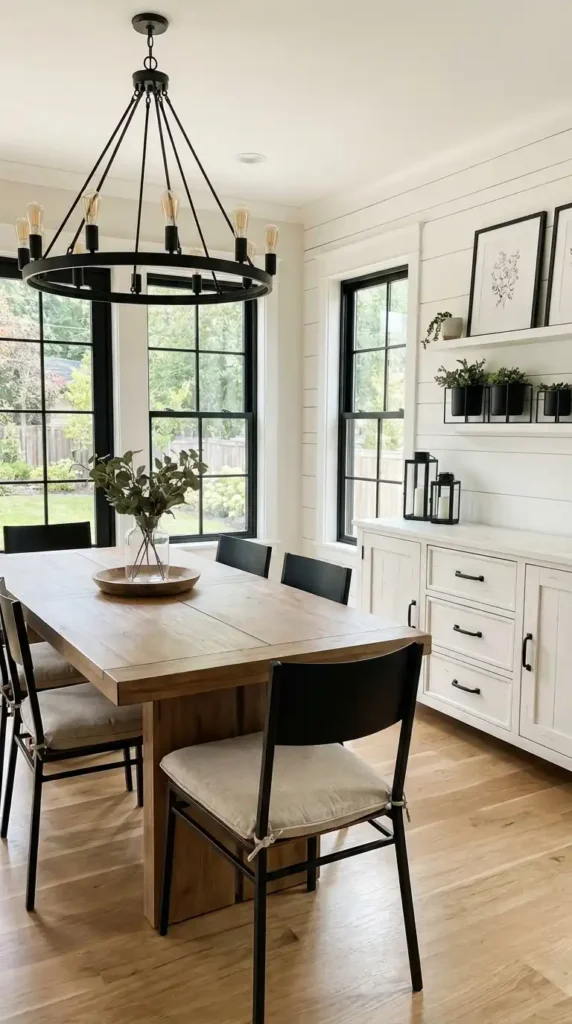
One of the clearest signals of a modern farmhouse dining room versus a purely
traditional or rustic farmhouse space is the presence of black metal. Black iron, black
steel, matte black powder-coated metal these accents are what bring the
contemporary edge that keeps this aesthetic from sliding into country-kitsch territory.
The key with black metal in a modern farmhouse dining room is to use it consistently
across multiple elements so that it reads as a deliberate design choice rather than an
accident. If your chandelier is black iron, echo that choice in your window frames (if
possible), your chair frames, your drawer pulls and hardware, and your accessories
candle holders, picture frames, hooks. This threading of a consistent metal finish
through the room creates visual cohesion that ties together otherwise disparate
elements.
Black metal dining chairs around a warm natural wood table are one of the most reliably
beautiful combinations in this style. The contrast between the warm, organic softness of
the wood and the cool, industrial precision of the metal is exactly the kind of tension
that makes modern farmhouse dining room design so visually compelling. Add a linen
or leather cushion pad to each chair seat for comfort and an extra layer of texture.
Industrial-style pendant lighting with black metal caging or pipe-style arms is another
strong direction. These fixtures have an authenticity that comes from their reference to
actual working environments factories, warehouses, old farm buildings which is
entirely consistent with the spirit of farmhouse design, updated for a contemporary
context.
Natural Fibers and Textile Layers
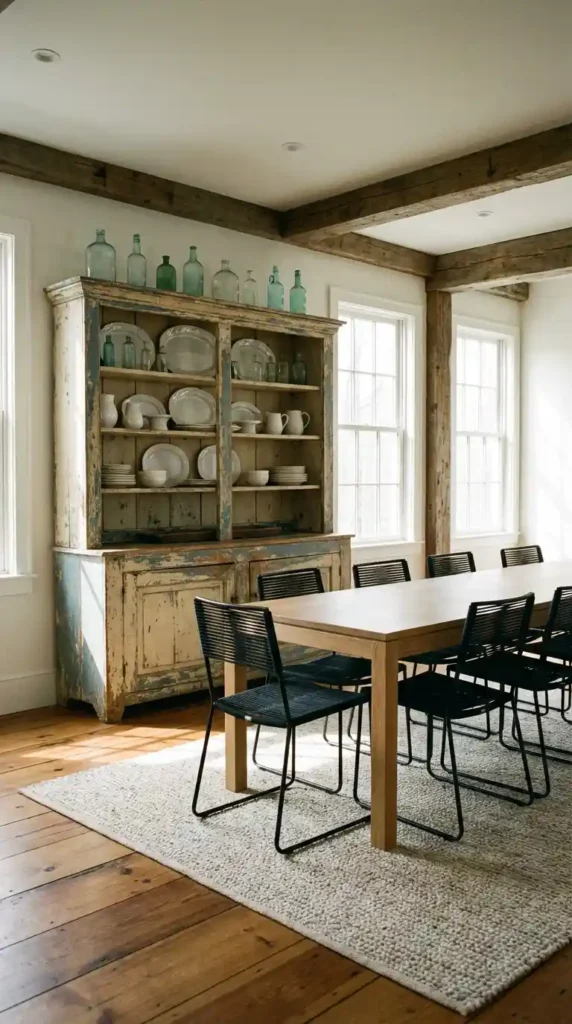
If you asked me to identify the single element that most consistently separates a truly
beautiful modern farmhouse dining room from one that’s trying but not quite there, I
would point to textiles. Specifically, the layering of natural fiber textiles linen, cotton,
jute, rattan, wool in a way that builds warmth and tactile richness without ever
becoming overwhelming.
Start with the rug. I cannot stress enough how much the right area rug transforms a
dining room. A natural fiber rug in jute or sisal is the most authentic farmhouse choice the texture is genuinely beautiful, the color reads as a warm neutral that works with
virtually everything, and it ages gracefully. Layered over a wood floor, a jute rug
practically makes the entire room look instantly more composed.
Layer linen into the dining chairs through cushion pads, and onto the table through a
simple linen runner or, for special occasions, a full table cloth with natural fringe or
tassel edge detail. Linen is the most forgiving of all textiles it wrinkles in a way that
looks intentional rather than careless, it washes beautifully, and it only gets softer and
more beautiful with age and use. It’s the ideal farmhouse fabric.
Don’t overlook woven rattan and cane as textile-adjacent materials. Rattan pendant
lights, cane-backed chairs, woven basket storage under a sideboard these organic
woven elements add an extra layer of warmth and natural material complexity that
enriches a modern farmhouse dining room without requiring any additional color or
pattern.
Vintage and Antique Pieces — The Character Builders

Nothing gives a modern farmhouse dining room more authenticity and character than
the presence of something genuinely old. This is one of those design principles that can’t
be faked or rather, it can be imitated, but the imitation will always feel like exactly
that. A piece with real age, real wear, and real history has a presence that new pieces, no
matter how skillfully distressed, simply don’t have.
In a modern farmhouse dining room, vintage pieces work best as statement pieces or
functional anchors. A genuinely old farmhouse table is the ultimate find the worn
surface, the slightly uneven legs, the patina that only comes from decades of daily use. If
you can find one, buy it immediately and build the rest of the room around it. It will give
your dining space something that no amount of budget can manufacture.
If a vintage table isn’t available or affordable, look for a vintage hutch or china cabinet
for the dining room wall. An old piece with original paint even chipped or worn
filled with a simple collection of ironstone pottery, white ceramic pitchers, and everyday
glass becomes an instant focal point that tells a visual story about the space. It says this
room wasn’t designed all at once, by one person, from one catalog. It says this room has
been lived in.
Antique or vintage light fixtures are another exceptional addition to a modern
farmhouse dining room. An old iron chandelier from an architectural salvage yard,
electrified and fitted with contemporary Edison bulbs, gives you genuine history at the
most prominent visual point in the room.
Plants and Greenery — Bringing the Outside In

There’s a reason farmhouse design has always had a close relationship with plants,
herbs, and growing things. The farmhouse aesthetic is fundamentally about a
connection to nature to the land, to growing seasons, to the honest beauty of organic
materials. Bringing living plants into your modern farmhouse dining room honors that
connection in the most direct possible way.
A large statement plant a fiddle leaf fig, a monstera, a potted olive tree in one
corner of the dining room immediately adds life and scale. These larger plants read as
sculptural elements at the same time as they’re living things, which gives them a unique
quality in a room that might otherwise be quite static. Position a large plant near a
window where it will get sufficient natural light and will also be backlit by that light
during the day.
Smaller plants styled on the sideboard or floating shelves trailing pothos, small
succulents in terracotta pots, a small fern in a basket layer in botanical interest at a
lower scale. The terracotta pot is worth highlighting specifically: it’s one of those
materials that is perfectly, completely aligned with the modern farmhouse aesthetic.
Unglazed terracotta has the warmth, texture, and honest-material quality that this style
prizes, and it gets better-looking with age as the clay absorbs mineral deposits and
develops a patina.
Styling tip: Group plants in odd numbers (three or five small pots together look more
interesting than two or four). Vary the heights. Include at least one trailing variety for
movement. These simple rules apply to any tabletop plant styling situation.
Open Shelving in the Dining Room — Display With
Purpose

Open shelving in a dining room is one of those ideas that either thrills people or terrifies
them, and I understand both reactions. Open shelves are essentially permanent, public-
facing displays of your stuff. If your stuff is beautiful and organized, this is a wonderful
opportunity. If it’s not if it’s a collection of mismatched plastic containers and stuff
you’re not sure what to do with then open shelving becomes a source of chronic low-
level stress every time you walk into the room.
In a modern farmhouse dining room, open shelving works best when it’s styled with a
specific philosophy: everyday beautiful things, organized simply. A row of floating
shelves on a shiplap or board-and-batten wall becomes a display of your actual dining
life the plates you eat from, the glasses you drink from, the serving pieces you love
organized in a way that looks as good as it functions.
The farmhouse approach to shelf styling isn’t about perfection. It’s about layering things
that make visual sense together: stacked plates in soft, muted colors; a row of simple
glasses; a ceramic pitcher or two; a small plant; a cookbook with a beautiful cover
propped against the back of the shelf. The goal is organized warmth, not museum-
quality precision.
Floating shelves in solid oak, walnut, or pine with a natural finish are the right choice for
a modern farmhouse dining room. Avoid the thin-profile pressed wood shelves that
come in flat-pack furniture ranges they look insubstantial and don’t carry the visual
weight that this aesthetic requires. A thick solid wood shelf bracket adds a structural,
honest quality that immediately reads as more authentic.
Galvanized Metal — The Detail That Says Farmhouse

If there’s one material detail that reads as unmistakably farmhouse more than
shiplap, more than mason jars, more than even the big reclaimed wood table it’s
galvanized metal. The dull, soft silver sheen of zinc-coated metal has its roots in genuine
agricultural use: watering cans, feed buckets, wash tubs, milk pails. Bringing it into a
dining room connects the space to that functional, working history in a way that feels
completely honest.
In a modern farmhouse dining room, galvanized metal works best as an accent material
rather than a primary one. Use it in your centerpiece a galvanized pitcher filled with
wildflowers or herb plants is a classic move that never gets old. Incorporate small
galvanized buckets as plant holders on a shelf or sideboard. A galvanized metal tray can
serve as a coffee station on a buffet or organize condiments on the dining table itself
during meals.
The key to using galvanized metal successfully in a modern farmhouse dining room is to
pair it with softer, warmer materials so that its industrial quality reads as a contrast
rather than a dominant tone. Against warm wood, soft linen, and matte white ceramics,
galvanized metal catches the light and adds a metallic sparkle that gives the room a
subtle visual dynamic without competing with the room’s overall warmth.
Wall Art — How to Choose and Arrange It
Art in a modern farmhouse dining room can go in several different directions, and all of
them can work beautifully the choice comes down to the story you want the room to
tell and the level of visual complexity you’re comfortable with this
The gallery wall is the most popular choice, and for good reason. A carefully assembled
collection of framed artwork on the dining room wall creates a focal point that’s
personal, layered, and infinitely adaptable over time. The farmhouse approach to gallery
walls favors a mix of print types — botanical illustrations, vintage farm imagery, simple
black-and-white photography, faded maps, handwritten quotes in clean typography —
united by consistent framing rather than consistent subject matter.
A single large-scale piece of art is an equally valid and often more impactful choice. One
substantial piece hung above a sideboard or on the main dining room wall makes a
strong visual statement and acts as the room’s visual anchor. For a modern farmhouse
dining room, look for art with organic qualities — botanical paintings, landscape
photography, abstract works in earthy and natural tones, or simple graphic prints that
reference nature.
Don’t overlook the option of a vintage or antique mirror as the main wall piece in a
dining room. An oversized mirror — especially one with an aged, distressed frame —
amplifies natural light, creates the illusion of additional space, and adds an element of
old-world elegance that sits beautifully within the modern farmhouse aesthetic. It’s also
endlessly flattering to the people sitting at the table, which is never a bad thing.
The Breakfast Nook — A Smaller Farmhouse Moment

Not everyone’s dining room is a dedicated, properly scaled formal dining space. Many
homes have a kitchen nook, a corner of the kitchen or living area, or a small eat-in space
that has to serve as the primary dining area. This is where modern farmhouse dining
room ideas can be particularly powerful because the farmhouse aesthetic actually
thrives in smaller, more intimate scales.
A built-in breakfast nook with a bench seat along one or two walls and a simple
farmhouse table is one of the most beloved modern farmhouse dining room formats for
small spaces. The built-in bench maximizes seating capacity in a tight footprint, creates
a sense of enclosure that feels cozy and intentional, and provides valuable under-seat
storage for table linens, seasonal decor, and other dining essentials.
For the nook to feel truly modern farmhouse rather than just small-kitchen-corner, it
needs a few specific elements: thick, comfortable seat cushions in a quality linen or
indoor-outdoor fabric (washable is practical wisdom for any family), a small pendant
light hung low above the table to create intimacy, and a warm paint color on the
surrounding walls this is one case where going darker on the walls can actually make
a small nook feel cozier rather than more claustrophobic.
A shiplap backing on the bench seat wall is a wonderful detail for a breakfast nook. At
the close viewing distance of a nook, the texture of shiplap reads more richly and
immediately than it does across a full-sized dining room, and it creates a very clear
visual frame for the seating area that makes the nook feel like its own designed space
within the larger room.
Seasonal Farmhouse Styling — Living With the Room
linen tablecloth; autumn with small gourds, pine cones, and warm candlelight; winter with bare
branches, white candles, and evergreen sprigs.
One of the things I love most about modern farmhouse dining room design is that it’s a
style that actively invites you to engage with it over time. It’s not a look you create once
and leave untouched it’s a living aesthetic that evolves with the seasons, with your
family’s changing life, and with the things you collect and accumulate.
Seasonal styling of a farmhouse dining room is simpler than it might sound, and it
doesn’t require buying a completely new set of accessories every three months. It’s
mainly about the centerpiece, a few textile changes, and the inclusion of seasonal
natural materials that you can often source from your own garden or the surrounding
landscape.
Spring means lighter textiles swap out the heavy wool throw on the bench for linen,
bring in fresh tulips or ranunculus, introduce soft green accents through new plants or a
pale sage runner on the table. Summer is for maximum lightness and brightness
wildflowers, herbs on the table, the lightest linen in natural undyed tones. Autumn is the
most generous of farmhouse seasons gourds, harvest branches, wheat, rich amber
candlelight, a heavier wool throw in rust or deep ochre. Winter calls for bare branches in
white vases, clusters of pillar candles, evergreen garlands, and the warm pool of light
from a dimmed chandelier.
This seasonal engagement with your modern farmhouse dining room is what makes it
feel genuinely alive rather than a static interior design statement. The room changes
with you. It reflects what’s happening outside the window. That quality is
fundamentally, irreducibly farmhouse and it’s one of the main reasons people fall so
deeply in love with this aesthetic once they experience it.
21–50: Quick Ideas to Inspire Every Corner of Your Space
wooden spoon displayed in a crock, a small chalkboard menu sign, a vintage clock, and a
woven rattan tray.
The ideas below are shorter in explanation but no less important in practice. These are
the finishing touches the details that take a modern farmhouse dining room from
good to genuinely wonderful.
- Add a wall clock
A large, simple wall clock — farmhouse-style in black or antique brass — above a
sideboard or on a dining room wall reads as both practical and deeply nostalgic. It’s one
of those objects that immediately signals home. - Use a linen tablecloth for special occasions
Keep a natural linen tablecloth for evenings when the table needs to feel more special.
The wrinkled quality of linen is part of its charm — it doesn’t need to be ironed perfectly
to look beautiful. - Try a dark, moody ceiling
Painting the ceiling of your modern farmhouse dining room in a deep charcoal, black, or
rich navy while keeping the walls light creates a dramatic, enveloping effect that makes
the room feel like a jewel box. It’s unexpected and spectacular. - Install a barn door
A sliding barn door between the kitchen and dining room — in natural wood or painted
to match the room’s palette — is one of those architectural details that is both deeply
practical (space-saving, noise-reducing) and deeply farmhouse in its character. - Add a reading nook bench along one wall
A simple wooden bench along one wall of the dining room topped with a cushion and
a couple of throw pillows adds extra seating for larger gatherings and creates a pause
point in the room that breaks the formality of chairs-only seating. - Use woven rattan placemats
Rattan or seagrass placemats on a farmhouse table are a detail so simple it barely
registers as a design decision but their presence adds a layer of organic texture that
makes the table setting feel immediately warmer and more considered.
- Incorporate a bookshelf or hutch
A farmhouse-style bookshelf or open hutch in the dining room styled with a mix of
ceramics, books, and a few plants creates a library-meets-dining-room quality that is
both beautiful and deeply livable. - Try a mix of warm and cool whites
Using a slightly cooler white on the walls and a warmer cream on the trim or
architectural details creates a subtle tonal depth that prevents an all-white modern
farmhouse dining room from feeling stark or flat. - Add a statement rug in an unexpected color
While natural jute is the classic choice, a faded Persian-style rug in muted jewel tones
brings an eclectic, collected quality to a modern farmhouse dining room that makes it
feel less designed and more discovered. - Use fresh herbs as functional decor
Pots of fresh rosemary, thyme, sage, and mint on the dining table or windowsill are at
once beautiful, fragrant, and genuinely useful. They’re also deeply, authentically
farmhouse in their connection to the kitchen and the garden. - Try wainscoting in a deeper color
Rather than painting wainscoting the same color as the upper wall, try a moodier, richer
version of the wall color or a coordinating deep green or slate blue for a
sophisticated, enveloping effect that grounds the room. - Incorporate dipped-wax taper candles
Simple beeswax taper candles in plain candlestick holders maybe a mix of heights and
finishes are one of the most evocative modern farmhouse dining room accessories. Lit
for dinner, they transform the atmosphere instantly. - Add a reclaimed wood floating shelf above the table
A single floating shelf in reclaimed wood above the dining table (high enough to clear
everyone’s heads) creates an architectural moment that can hold plants, candles, or a
small art piece and makes use of vertical wall space that often goes ignored. - Use baskets for under-table or sideboard storage
Woven baskets in natural materials tucked under a sideboard or visible shelf bring
practical storage into the aesthetic a very farmhouse-minded approach to the eternal
dining room problem of where to put everything. - Add a cow-hide or woven wool accent rug
Layering a smaller cow-hide or woven wool rug over a larger natural fiber rug adds a
layer of visual interest and tactile richness that makes the dining area feel more dynamic
and dimensional. - Include a vintage wooden crate or fruit box as decor
An old wooden wine crate or fruit box original lettering intact used as a base for a
plant, a stack of books, or a collection of bottles on the sideboard is the kind of thrift-
store find that adds more character than almost anything you could buy new. - Try painted chairs in a single unexpected color
While white is the classic painted chair choice in a modern farmhouse dining room,
consider a soft sage green, a dusky blue, or a faded terracotta. A single unexpected color
on the chairs can warm up an otherwise neutral room dramatically. - Use a long wooden dining bench as a console behind chairs
A long, low wooden bench positioned behind one row of dining chairs like a hallway
console can hold bags, a laptop, or simply be styled with a plant and a candle. It adds
depth and layering to the dining area without using additional floor space. - Install picture rail molding
Picture rail molding running around the upper walls of a dining room is a wonderful
period detail that also gives you the practical ability to hang art anywhere on the wall
without putting a single nail hole in the plaster — and it’s very easy to DIY.
- Mix linen and leather on dining chairs
Linen seat pads and leather chair backs or vice versa on the same chair is a material
combination that is both practical (leather wipes clean, linen cushions) and beautifully
tactile in a way that pure linen or pure leather alone rarely achieves. - Use a tiered fruit stand as a centerpiece
A simple tiered wooden or metal fruit stand in the center of the dining table filled
with seasonal fruit, pine cones, or small potted plants is a wonderfully utilitarian
piece of farmhouse decor that earns its place by being genuinely useful. - Add a wall-mounted utensil display
In a dining room that opens to the kitchen, a wall-mounted display of beautiful cooking
utensils wooden spoons, copper ladles, cast-iron pans — on simple iron hooks creates
a functional art installation that is quintessentially farmhouse. - Try a statement fireplace surround
If your dining room has or could have a fireplace, a simple white shiplap or board-and-
batten fireplace surround is one of the most powerfully farmhouse architectural
moments you can create especially styled with a simple wooden mantel. - Use dried botanicals as long-lasting arrangements
Dried pampas grass, wheat sheaves, dried lavender, and preserved eucalyptus
arrangements last for months or years without water or maintenance while maintaining
their organic, natural quality. They’re the practical farmhouse alternative to fresh
flowers. - Add subtle geometric pattern through textiles
A very simple geometric pattern a thin stripe, a small check, or a subtle diamond in
a dining chair cushion or table runner introduces visual interest without adding the
complexity of florals or traditional motifs. It bridges the modern and farmhouse halves
of the aesthetic neatly.
- Create a coffee or drink station on the sideboard
Dedicating one end of the sideboard to a styled coffee or drink station a quality kettle,
a French press, a few beautiful mugs, a small tray of sugar and cream adds a layer of
welcoming hospitality to the dining room that guests genuinely appreciate. - Use a chalkboard wall or panel for seasonal menus
A chalkboard panel on one wall of a modern farmhouse dining room or even just a
framed chalkboard hung on the wall lets you write seasonal menus, quotes, or simple
drawings that change throughout the year. It’s playful, personal, and very farmhouse. - Embrace imperfection in your styling
This is perhaps the most important piece of advice in this entire article. The modern
farmhouse dining room is not a showroom. It should look like people eat there, live
there, and enjoy being there. Let things be slightly imperfect. Let the pillow be a little
askew. Let the flowers in the pitcher be just starting to open rather than perfectly
arranged. That’s the whole point. - Invest in quality linen napkins and use them daily
Cloth napkins particularly linen napkins in natural or white tones are one of the
simplest and most immediately effective farmhouse upgrades you can make to your
dining room. They change the feeling of every meal from functional to slightly
ceremonious, which is exactly what a farmhouse dining room should do. - Let the room evolve over time
The best modern farmhouse dining rooms aren’t created in a single weekend or a single
shopping trip. They’re built over years, piece by piece, as you find the right table at an
estate sale, the perfect lamp at a flea market, the art print that speaks to you at a craft
fair. The room should tell the story of your life lived in it. That story takes time to write and the longer you give it, the richer it becomes.
Pulling It All Together — Your Action Plan

After going through 50 modern farmhouse dining room ideas, you’re probably feeling
one of two things: inspired and ready to tackle your space, or slightly overwhelmed by
the number of decisions involved. Both are completely reasonable responses, and I want
to leave you with something practical.
Start with the bones. Before you buy a single accessory or choose a paint color, assess
what you’re working with structurally. What’s your ceiling height? What’s the quality of
your natural light? What’s the existing flooring situation? The answers to these
questions determine your priorities and prevent you from spending money on the wrong
things first.
Then work in layers. Furniture first table, chairs, and any major case pieces like a
sideboard. Then the big architectural moves shiplap, wall treatment, lighting. Then
the soft goods rug, curtains, cushions. Then the accessories art, plants, centerpiece,
smaller decor objects. This order ensures that every decision is made in the context of
what’s already in the room, and that each layer enhances rather than competes with the
ones before it.
And give yourself permission to take your time. The modern farmhouse dining rooms
you see in magazines and on design blogs that truly stop you in your tracks — they didn’t
happen in a weekend. They happened over years, through trial and error, through
finding the right piece at the wrong time and putting it in storage until the room was
ready for it, through living with things that weren’t quite right and gradually replacing
them with things that were. That process isn’t a failure of planning. It’s the work. And
it’s worth it.
Your dining room should be the room in your house where people automatically slow
down, pull up a chair, and stay a little longer than they meant to. That’s what modern
farmhouse dining room design does, when it’s done right. And you absolutely can do it
right.
Final Thought
A great modern farmhouse dining room isn’t a design project you complete. It’s a space
you build a relationship with over time a room that becomes the backdrop for your
family’s best hours together. Get the bones right, trust your instincts on the details.
Frequently Asked Questions
1. What is the difference between a modern farmhouse dining room and a
traditional farmhouse dining room?
A Traditional farmhouse dining rooms lean heavily into country and rustic elements —
rough-hewn wood, vintage country accessories, floral prints, painted cabinets in heritage
colors. Modern farmhouse dining rooms take those same rustic materials and pair them
with contemporary design sensibilities: clean lines, neutral palettes, black metal accents,
and a restraint in decoration that prevents the space from feeling cluttered or overtly
‘country’. The difference is in the editing as much as the individual choices.
2. What colors work best in a modern farmhouse dining room?
The foundational palette is warm white, natural wood tones, and black or near-black
metal accents. From that base, the most popular accent colors include sage green, dusty
blue-grey, soft terracotta, greige (grey-beige), and deep charcoal. The key is to choose colors
with warm undertones that feel organic and grounded rather than cold or clinical.
3. What kind of table is best for a modern farmhouse dining room?
A large, solid wood table with natural character visible grain, knots, and a matte or
natural finish is ideal. Reclaimed wood tables are the most authentic choice. Trestle or
pedestal bases work beautifully. The most modern farmhouse direction is to contrast a
warm natural wood top with darker or black metal legs.
4. Can I create a modern farmhouse dining room on a budget?
Absolutely. The single highest-impact, lowest-cost change you can make is a fresh coat of
warm white paint on the walls. After that, a quality area rug (even from a budget retailer)
transforms the space dramatically. Shiplap and board-and-batten are genuinely inexpensive
DIY projects. Thrift stores, estate sales, and Facebook Marketplace are excellent sources for
the kind of aged, character-rich pieces that define this aesthetic — often at a fraction of new
retail prices.
5. What lighting works best in a modern farmhouse dining room?
A statement chandelier or pendant centered above the dining table is the most impactful
choice. Wagon wheel chandeliers in black iron, industrial-style pendant clusters with Edison
bulbs, rattan dome pendants, and lantern-style fixtures all work beautifully. Always install a
dimmer switch so the room can transition between casual and intimate lighting as needed.
6. How big should the chandelier be over a farmhouse dining table?
A general guideline is that the chandelier diameter should be roughly half to two-thirds
the width of your dining table. For height, hang the bottom of the fixture approximately 30
to 36 inches above the tabletop in rooms with standard ceiling heights. In rooms with higher
ceilings (10 feet or above), you can hang it slightly higher.
7: What chairs go with a modern farmhouse dining table?
Almost any chair works with the right approach. Popular choices include linen
upholstered parsons chairs, natural wood Wishbone or Windsor chairs, black metal chairs
with upholstered seats, and ladder-back chairs in natural or painted finishes. The
farmhouse approach often mixes chair types bench seating on one side, individual chairs
on the other, and upholstered armchairs at the heads.
8. Should I use a rug in my farmhouse dining room?
Yes, in most cases. A rug defines the dining seating area, adds warmth and texture, and
makes the room feel more finished. Choose a rug that extends at least 24 inches beyond all
sides of the dining table so that chairs remain on the rug when pulled out for seating.
Natural fiber rugs in jute or sisal are the most authentically farmhouse choice.
9. What is shiplap and why is it so popular in farmhouse design?
Shiplap is a type of wooden board (or its imitation) with a horizontal tongue-and-groove
profile that leaves a small shadow gap between planks when installed on a wall. It became
synonymous with farmhouse design largely through Joanna Gaines’ work on HGTV’s Fixer
Upper. Its popularity stems from its ability to add architectural texture and warmth to a wall
without adding color or pattern complexity it’s essentially a textural neutral
10. Can I do modern farmhouse in a small dining room?
Yes, and in some ways the aesthetic works even better in smaller, more intimate dining
spaces. Scale your furniture appropriately — a round table often works better than a large
rectangular one in a small room. A built-in bench creates comfortable seating with minimal
footprint. Keep the color palette light to maximize the sense of space. One well-chosen
accent wall with shiplap or board-and-batten adds character without making the room feel
smaller.